But by the time of Solon in the sixth century B.C., something different is happening. The poet is no longer simply given his gifts; he has to have "learning in the gift of the Muses" (Fragment 13:51). And then, in the fifth century B.C., we hear the very first hint of poets' being peculiar with poetic ecstasy. What a contrast to the calm and stately manner of the earlier aoido1, Demodocus, for example! It is Democritus who insists that no one can be a great poet without being frenzied up into a state of fury (Fragment 18).

And then in the fourth century B.C., the mad possessed poet "out of his senses" that Plato and I have already described. Just as the oracles had changed from the prophet who heard his hallucinations to the possessed person in a wild trance, so also had the poet.

Was this dramatic change because the collective cognitive im perative had made the Muses less believable as real external entities? Or was it because the neurological reorganization of hemispheric relations brought on by developing consciousness prohibited such givenness; so that consciousness had to be out of the way to let poetry happen? Or was it Wernicke's area on the right hemisphere using Broca's area on the left, thus short-circuiting (as it were) normal consciousness? Or are these three hypotheses the same (as of course I presently think they are)?

For whatever reasons, decline continues decline in the ensuing centuries. Just as the oracles sputtered out through their latter terms until possession was partial and erratic, so, I suggest, poets slowly changed until the fury and possession by the Muses was also partial and erratic. And then the Muses hush and freeze into myths. Nymphs and shepherds, dance no more. Consciousness is a witch beneath whose charms pure inspiration gasps and dies into invention. The oral becomes written by the poet himself, and written, it should be added, by his right hand, worked by his left hemisphere. The Muses have become imaginary and invoked in their silence as a part of man's nostalgia for the bicameral mind.

In summary, then, the theory of poetry I am trying to state in this scraggly collation of passages is similar to the theory I presented for oracles. Poetry begins as the divine speech of the bicameral mind. Then, as the bicameral mind breaks down, there remain prophets. Some become institutionalized as oracles making decisions for the future. While others become specialized into poets, relating from the gods statements about the past.

Then, as the bicameral mind shrinks back from its impulsiveness, and as perhaps a certain reticence falls upon the right hemisphere, poets who are to obtain this same state must learn to do it. As this becomes more difficult, the state becomes a fury, and then ecstatic possession, just as happened in the oracles. And then indeed toward the end of the first millennium B.c., just as the oracles began to become prosaic and their statements versified consciously, so poetry also. Its givenness by the unison Muses has vanished. And conscious men now wrote and crossed out and careted and rewrote their compositions in laborious mimesis of the older divine utterances.

Why as the gods retreated even further into their silent heavens or, in another linguistic mode, as auditory hallucinations shrank back from access by left hemisphere monitoring mecha-nisms, why did not the dialect of the gods simply disappear?
Why did not poets simply cease their rhapsodic practices as did the priests and priestesses of the great oracles? The answer is very clear. The continuance of poetry, its change from a divine given to a human craft is part of that nostalgia for the absolute.  The search for the relationship with the lost otherness of divine directives would not allow it to lapse. And hence the frequency even today with which poems are apostrophes to often unbelieved-in entities, prayers to unknown imaginings. And hence the opening paragraph of this treatise. The forms are still there, to be worked with now by the analog 'I' of a conscious poet. His task now is an imitation or mimesis of the former type of poetic utterance and the reality which it expressed. Mimesis in the bicameral sense of mimicking what was heard in hallucination has moved through the mimesis of Plato as representation of reality to mimesis as imitation with invention in its sullen service.

There have been some latter-day poets who have been very specific about actual auditory hallucinations. Milton referred to his "Celestial Patroness, who ... unimplord... dictates to me my unpremeditated Verse," even as he, in his blindness, dictated it to his daughters.? And Blake's extraordinary visions and auditory hallucinations — sometimes going on for days and sometimes against his will — as the source of his painting and poetry are well known. And Rilke is said to have feverishly copied down a long sonnet sequence that he heard in hallucination.  But most of us are more ordinary, more with and of our time. We no longer hear our poems directly in hallucination. It is instead the feeling of something being given and then nourished into being, of the poem happening to the poet, as well and as much as being created by him. Snatches of lines would "bubble up" for Housman after a beer and a walk "with sudden and unaccountable emotions" which then "had to be taken in hand and completed by the brain." "The songs made me, not I them," said Goethe. "It is not I who think," said Lamartine, "it is my ideas that think for me." And dear Shelley said it plain:

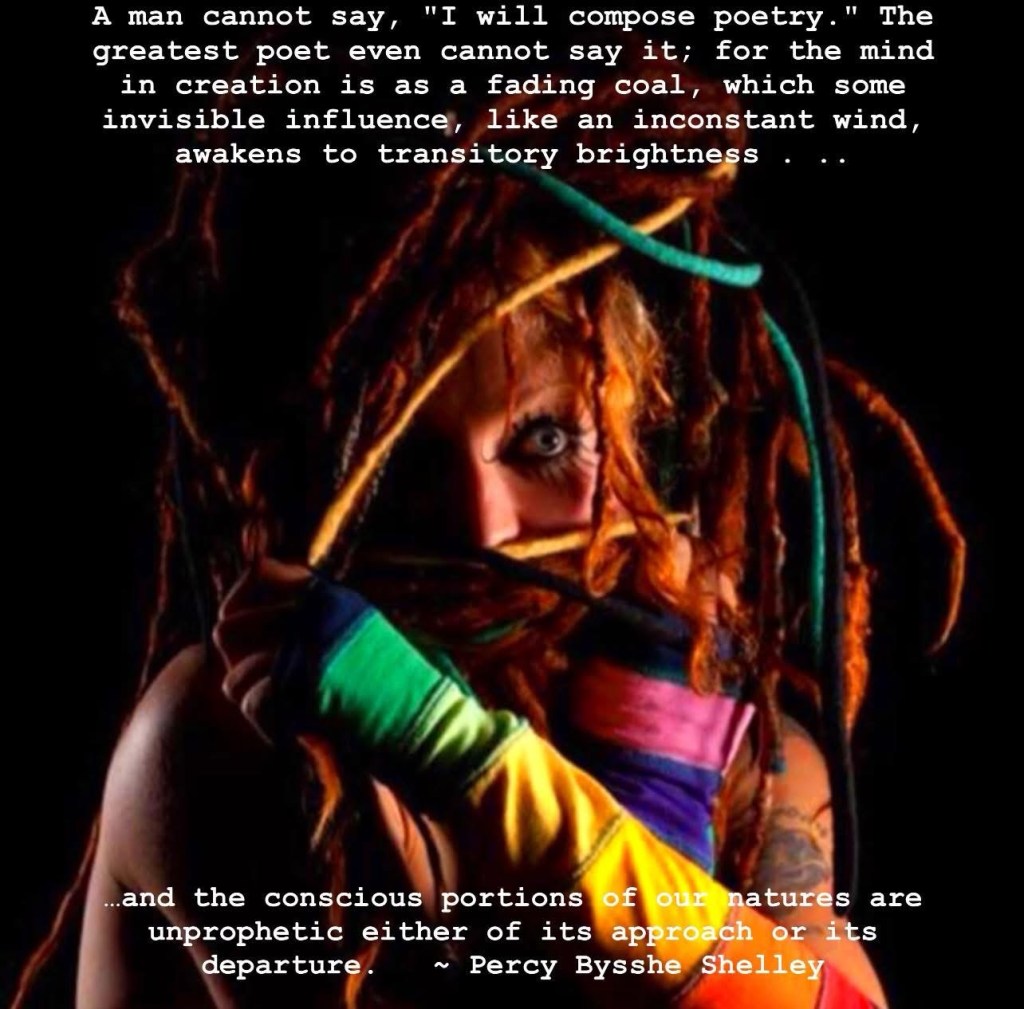
“A man cannot say, "I will compose poetry." The greatest poet even cannot say it; for the mind in creation is as a fading coal, which some invisible influence, like an inconstant wind, awakens to transitory brightness . .. and the conscious portions of our natures are unprophetic either of its approach or its departure.”

Is the fading coal the left hemisphere and the inconstant wind the right, mapping vestigially the ancient relationship of men to gods?

Of course there is no universal rule in this matter. The nervous systems of poets come like shoes, in all types and sizes, though with a certain irreducible topology. We know that the relations of the hemispheres are not the same in everyone. In-deed, poetry can be written without even a nervous system. A vocabulary, some syntax, and a few rules of lexical fit and measure can be punched into a computer, which can then proceed to write quite 'inspired' if surrealist verse. But that is simply a copy of what we, with two cerebral hemispheres and nervous systems, already do. Computers or men can indeed write poetry without any vestigial bicameral inspiration. But when they do, they are imitating an older and a truer poesy out there in history. Poetry, once started in mankind, needs not the same means for its pro-duction. It began as the divine speech of the bicameral mind. And even today, through its infinite mimeses, great poetry to the listener, however it is made, still retains that quality of the wholly other, of a diction and a message, a consolation and an inspira-tion, that was once our relationship to gods.

~ Julian Jaynes, Tbe Origin of Consciousness  in the Breakdown  of the Bicameral Mind
WHAT is Love? Ask him who lives, what is life; ask him who adores, what is God?
I know not the internal constitution of other men, nor even thine, whom I now address. I see that in some external attributes they resemble me, but when, misled by that appearance, I have thought to appeal to something in common, and unburthen my inmost soul to them, I have found my language misunderstood, like one in a distant and savage land. The more opportunities they have afforded me for experience, the wider has appeared the interval between us, and to a greater distance have the points of sympathy been withdrawn. With a spirit ill fitted to sustain such proof, trembling and feeble through its tenderness, I have everywhere sought sympathy, and have found only repulse and disappointment.
Thou demandest what is Love. It is that powerful attraction towards all we conceive, or fear, or hope beyond ourselves, when we find within our own thoughts the chasm of an insufficient void, and seek to awaken in all things that are, a community with what we experience within ourselves. If we reason, we would be understood; if we imagine, we would that the airy children of our brain were born anew within another’s; if we feel, we would that another’s nerves should vibrate to our own, that the beams of their eyes should kindle at once and mix and melt into our own; that lips of motionless ice should not reply to lips quivering and burning with the heart’s best blood. This is Love. This is the bond and the sanction which connects not only man with man, but with every thing which exists. We are born into the world, and there is something within us which, from the instant that we live, more and more thirsts after its likeness. It is probably in correspondence with this law that the infant drains milk from the bosom of its mother; this propensity developes itself with the developement of our nature. We dimly see within our intellectual nature a miniature as it were of our entire self, yet deprived of all that we condemn or despise, the ideal prototype of every thing excellent and lovely that we are capable of conceiving as belonging to the nature of man. Not only the portrait of our external being, but an assemblage of the minutest particles of which our nature is composed;* a mirror whose surface reflects only the forms of purity and brightness; a soul within our own soul that describes a circle around its proper Paradise, which pain and sorrow and evil dare not overleap. To this we eagerly refer all sensations, thirsting that they should resemble or correspond with it. The discovery of its antitype; the meeting with an understanding capable of clearly estimating our own; an imagination which should enter into and seize upon the subtle and delicate peculiarities which we have delighted to cherish and unfold in secret; with a frame whose nerves, like the chords of two exquisite lyres, strung to the accompaniment of one delightful voice, vibrate with the vibrations of our own; and of a combination of all these in such proportion as the type within demands; this is the invisible and unattainable point to which Love tends; and to attain which, it urges forth the powers of man to arrest the faintest shadow of that, without the possession of which there is no rest nor respite to the heart over which it rules. Hence in solitude, or in that deserted state when we are surrounded by human beings, and yet they sympathize not with us, we love the flowers, the grass, the waters, and the sky. In the motion of the very leaves of spring, in the blue air, there is then found a secret correspondence with our heart. There is eloquence in the tongueless wind, and a melody in the flowing brooks and the rustling of the reeds beside them, which by their inconceivable relation to something within the soul, awaken the spirits to a dance of breathless rapture, and bring tears of mysterious tenderness to the eyes, like the enthusiasm of patriotic success, or the voice of one beloved singing to you alone. Sterne says that if he were in a desert he would love some cypress. So soon as this want or power is dead, man becomes the living sepulchre of himself, and what yet survives is the mere husk of what once he was.

 BlissNinja