🌟Rank asked why the artist so often avoids clinical neurosis when he is so much a candidate for it because of his vivid imagination, his openness to the finest and broadest aspects of experience, his isolation from the cultural world-view that satisfies everyone else. The answer is that he takes in the world, but instead of being oppressed by it he reworks it in his own personality and recreates it in the work of art. The neurotic is precisely the one who cannot create—the “artiste-manque,” as Rank so aptly called him. We might say that both the artist and the neurotic bite off more than they can chew, but the artist spews it back out again and chews it over in an objectified way, as an external, active, work project. The neurotic can’t marshal this creative response embodied in a specific work, and so he chokes on his introversions. The artist has similar large-scale introversions, but he uses them as material.🌟
:::🌟Ernest Becker, The Denial of Death
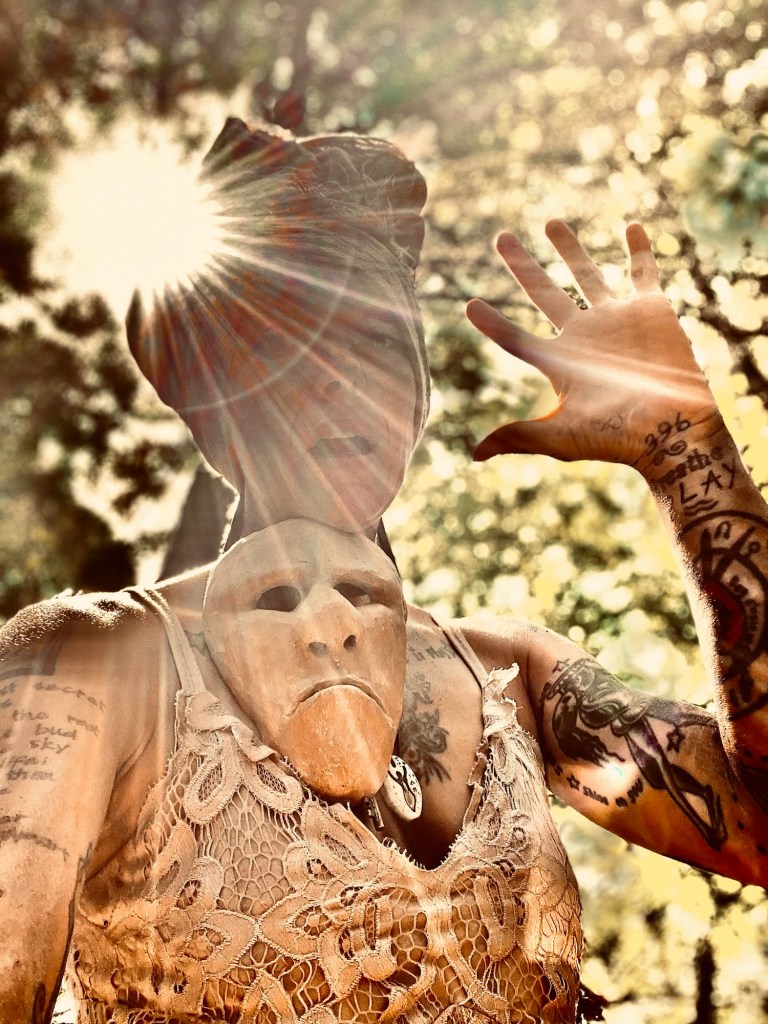
{Self Portrait Series 8-7-24 part 2}
The road to creativity passes so close to the madhouse and often detours or ends there. Ernest Becker, The Denial of DeathMan cannot endure his own littleness unless he can translate it into meaningfulness on the largest possible level.
Ernest Becker, The Denial of DeathThe irony of man’s condition is that the deepest need is to be free of the anxiety of death and annihilation; but it is life itself which awakens it, and so we must shrink from being fully alive.
Ernest Becker, The Denial of DeathThe neurotic exhausts himself not only in self-preoccupations like hypochondrial fears and all sorts of fantasies, but also in others: those around him on whom he is dependent become his therapeutic work project; he takes out his subjective problems on them. But people are not clay to be molded; they have needs and counter-wills of their own. The neurotic’s frustration as a failed artist can’t be remedied by anything but an objective creative work of his own. Another way of looking at it is to say that the more totally one takes in the world as a problem, the more inferior or “bad” one is going to feel inside oneself. He can try to work out this “badness” by striving for perfection, and then the neurotic symptom becomes his “creative” work; or he can try to make himself perfect by means his partner. But it is obvious to us that the only way to work on perfection is in the form of an objective work that is fully under your control and is perfectible in some real ways. Either you eat up yourself and others around you, trying for perfection; or you objectify that imperfection in a work, on which you then unleash your creative powers. In this sense, some kind of objective creativity is the only answer man has to the problem of life. In this way he satisfies nature, which asks that he live and act objectively as a vital animal plunging into the world; but he also satisfies his own distinctive human nature because he plunges in on his own symbolic terms and not as a reflex of the world as given to mere physical sense experience. He takes in the world, makes a total problem out of it, and then gives out a fashioned, human answer to that problem. This, as Goethe saw in Faust, is the highest that man can achieve.
Ernest Becker, The Denial of DeathIn Jung’s terms-that we noted previously-the work is the artist’s own transference projection, and he knows that consciously and critically. Whatever he does he is stuck with himself, can’t get securely outside and beyond himself. He is also stuck with the work of art itself. Like any material achievement it is visible, earthly, impermanent. No matter how great it is, it still pales in some ways next to the transcending majesty of nature; and so it is ambiguous, hardly a solid immortality symbol. In his greatest genius man is still mocked. No matter that historically art and psychosis have had such an intimate relationship, that the road to creativity passes so close to the madhouse and often detours or ends there. The artist and the madman are trapped by their own fabrications; they wallow in their own anality, in their protest that they really are something special in creation.
Ernest Becker, The Denial of DeathThe most that any one of us can seem to do is to fashion something–an object or ourselves–and drop it into the confusion, make an offering of it, so to speak, to the life force.
Ernest Becker, The Denial of DeathGuilt results from unused life, from the unlived in us.
Ernest Becker, The Denial of DeathAnd so we see the paradox that evolution has handed us. If man is the only animal whose consciousness of self gives him an unusual dignity in the animal kingdom, he also pays a tragic price for it. The fact that the child has to identify -first- means that his very first identity is a social product. His habitation of his own body is built from the outside in; not from the inside out. He doesn’t unfold into the world, the world unfolds into him. As the child responds to the vocal symbols learned from his object, he often gives the pathetic impression of being a true social puppet, jerked by alien symbols and sounds. What sensitive parent does not have his satisfaction tinged with sadness as the child repeats with such vital earnestness the little symbols that are taught him?
Ernest Becker, The Birth and Death of Meaning: An Interdisciplinary Perspective on the Problem of ManMan cuts out for himself a manageable world: he throws himself into action uncritically, unthinkingly. He accepts the cultural programming that turns his nose where he is supposed to look; he doesn’t bite the world off in one piece as a giant would, but in small manageable pieces, as a beaver does. He uses all kinds of techniques, which we call the “character defenses”: he learns not to expose himself, not to stand out; he learns to embed himself in other-power, both of concrete persons and of things and cultural commands; the result is that he comes to exist in the imagined infallibility of the world around him. He doesn’t have to have fears when his feet are solidly mired and his life mapped out in a ready-made maze. All he has to do is to plunge ahead in a compulsive style of drivenness in the “ways of the world.
Ernest Becker, The Denial of Death[Man] literally drives himself into a blind obliviousness with social games, psychological tricks, personal preoccupations so far removed from the reality of his situation that they are forms of madness, but madness all the same.
Ernest Becker, The Denial of DeathTo grow up at all is to conceal the mass of internal scar tissue that throbs in our dreams.
Ernest Becker, The Denial of DeathBy the time the child grows up, the inverted search for a personal existence through perversity gets set in an individual mold, and it becomes more secret. It has to be secret because the community won’t stand for the attempt by people to wholly individualize themselves. If there is going to be a victory over human incompleteness and limitation, it has to be a social project and not an individual one. Society wants to be the one to decide how people are to transcend death; it will tolerate the causa-sui project only if it fits into the standard social project. Otherwise there is the alarm of “Anarchy!” This is one of the reasons for bigotry and censorship of all kinds over personal morality: people fear that the standard morality will be undermined-another way of saying that they fear they will no longer be able to control life and death. A person is said to be “socialized” precisely when he accepts to “sublimate” the body-sexual character of his Oedipal project. Now these euphemisms mean usually that he accepts to work on becoming the father of himself by abandoning his own project and by giving it over to “The Fathers.” The castration complex has done its work, and one submits to “social reality”; he can now deflate his own desires and claims and can play it safe in the world of the powerful elders. He can even give his body over to the tribe, the state, the embracing magic umbrella of the elders and their symbols; that way it will no longer be a dangerous negation for him. But there is no real difference between a childish impossibility and an adult one; the only thing that the person achieves is a practiced self-deceit-what we call the “mature” character.
Ernest Becker, The Denial of DeathThe ironic thing about the narrowing-down of neurosis is that the person seeks to avoid death, but he does it by killing off so much of himself and so large a spectrum of his action-world that he is actually isolating and diminishing himself and becomes as though dead. There is just no way for the living creature to avoid life and death, and it is probably poetic justice that if he tries too hard to do so he destroys himself.
Ernest Becker, The Denial of DeathKierkegaard gives us some portrait sketches of the styles of denying possibility, or the lies of character-which is the same thing. He is intent on describing what we today call “inauthentic” men, men who avoid developing their own uniqueness; they follow out the styles of automatic and uncritical living in which they were conditioned as children. They are “inauthentic” in that they do not belong to themselves, are not “their own” person, do not act from their own center, do not see reality on its terms; they are the one-dimensional men totally immersed in the fictional games being played in their society, unable to transcend their social conditioning: the corporation men in the West, the bureaucrats in the East, the tribal men locked up in tradition-man everywhere who doesn’t understand what it means to think for himself and who, if he did, would shrink back at the idea of such audacity and exposure.
Ernest Becker, The Denial of DeathAnthropologists have long known that when a tribe of people lose their feeling that their way of life is worth-while they may stop reproducing, or in large numbers simply lie down and die beside streams full of fish: food is not the primary nourishment of man.
Ernest Becker, The Birth and Death of Meaning: An Interdisciplinary Perspective on the Problem of ManBeyond a given point man is not helped by more “knowing,” but only by living and doing in a partly self-forgetful way. As Goethe put it, we must plunge into experience and then reflect on the meaning of it. All reflection and no plunging drives us mad; all plunging and no reflection, and we are brutes.
Ernest Becker, The Denial of DeathTake stock of those around you and you will … hear them talk in precise terms about themselves and their surroundings, which would seem to point to them having ideas on the matter. But start to analyse those ideas and you will find that they hardly reflect in any way the reality to which they appear to refer, and if you go deeper you will discover that there is not even an attempt to adjust the ideas to this reality. Quite the contrary: through these notions the individual is trying to cut off any personal vision of reality, of his own very life. For life is at the start a chaos in which one is lost. The individual suspects this, but he is frightened at finding himself face to face with this terrible reality, and tries to cover it over with a curtain of fantasy, where everything is clear. It does not worry him that his “ideas” are not true, he uses them as trenches for the defense of his existence, as scarecrows to frighten away reality.
Ernest Becker, The Denial of DeathThe man of knowledge in our time is bowed down under a burden he never imagined he would ever have: the overproduction of truth that cannot be consumed.
Ernest Becker, The Denial of DeathThere is no doubt that creative work is itself done under a compulsion often indistinguishable from a purely clinical obsession. In this sense, what we call a creative gift is merely the social license to be obsessed. And what we call “cultural routine” is a similar license: the proletariat demands the obsession of work in order to keep from going crazy. I used to wonder how people could stand the really demonic activity of working behind those hellish ranges in hotel kitchens, the frantic whirl of waiting on a dozen tables at one time, the madness of the travel agent’s office at the height of the tourist season, or the torture of working with a jack-hammer all day on a hot summer street. The answer is so simple that it eludes us: the craziness of these activities is exactly that of the human condition. They are “right” for us because the alternative is natural desperation. The daily madness of these jobs is a repeated vaccination against the madness of the asylum. Look at the joy and eagerness with which workers return from vacation to their compulsive routines. They plunge into their work with equanimity and lightheartedness because it drowns out something more ominous.
Ernest Becker, The Denial of DeathIn other words, as long as man is an ambiguous creature he can never banish anxiety; what he can do instead is to use anxiety as an eternal spring for growth into new dimensions of thought and trust. Faith poses a new life task, the adventure in openness to a multi-dimensional reality.
Ernest Becker, The Denial of DeathPeople create the reality they need in order to discover themselves.
Ernest Becker, The Denial of DeathThe “healthy” person, the true individual, the self-realized soul, the “real” man, is the one who has transcended himself.
Ernest Becker, The Denial of DeathThe great boon of repression is that it makes it possible to live decisively in an overwhelmingly miraculous and incomprehensible world, a world so full of beauty, majesty, and terror that if animals perceived it all they would be paralyzed to act. … What would the average man (sic) do with a full consciousness of absurdity? He has fashioned his character for the precise purpose of putting it between himself and the facts of life; it is his special tour-de-force that allows him to ignore incongruities, to nourish himself on impossibilities, to thrive on blindness. He accomplishes thereby a peculiarly human victory: the ability to be smug about terror.
Ernest Becker, The Denial of DeathTake the average man who has to stage in his own way the life drama of his own worth and significance. As a youth he, like everyone else, feels that deep down he has a special talent, an indefinable but real something to contribute to the richness and success of life in the universe. But, like almost everyone else, he doesn’t seem to hit on the unfolding of this special something; his life takes on the character of a series of accidents and encounters that carry him along, willy-nilly, into new experiences and responsibilities. Career, marriage, family, approaching old age – all these happen to him, he doesn’t command them. Instead of his staging the drama of his own significance, he himself is staged, programmed by the standard scenario laid down by his society.
Ernest Becker, Angel in Armor: A Post-Freudian Perspective on the Nature of ManSecrets and silences make life more real: the individual, self-absorbed and inwardly musing, taking himself very seriously, radiates a contagious aura: the tacit communication that the serious and the meaningful exist.
Ernest Becker, The Birth and Death of Meaning: An Interdisciplinary Perspective on the Problem of ManKierkegaard put it this way: But while one sort of despair plunges wildly into the infinite and loses itself, a second sort permits itself as it were to be defrauded by “the others.” By seeing the multitude of men about it, by getting engaged in all sorts of wordly affairs, by becoming wise about how things go in this world, such a man forgets himself… does not dare to believe in himself, finds it too venturesome a thing to be himself, far easier and safer to be like the others, to become an imitation, a number, a cipher in the crowd.
Ernest Becker, The Denial of DeathWe fear our highest possibility (as well as our lowest ones). We are generally afraid to become that which we can glimpse in our most perfect moments…. We enjoy and even thrill to the godlike possibilities we see in ourselves in such peak moments. And yet we simultaneously shiver with weakness, awe and fear before these very same possibilities.



















 BlissNinja