The pathologized images have moved the soul in several ways: we are afraid; we feel vulnerable and in danger; our very physical substance and sanity appear to be menaced; we want to prevent or rectify. Especially this last seizes us. We feel protective, impelled to correct, straighten, repair. For we have confused something sick with something wrong. […] affliction reaches us partly through the guilt it brings. Guilt belongs to the experiences of deviation, the the sense of being off, failing, ‘missing the mark’. […] However the true missing of the mark is taking the guilt literally, where failings becomes faults to be set right. This places the guilt on the shoulders of the ego who ‘should not’ have failed. Then pathologizing reinforces the ego’s style and guilt serves a secondary gain, increasing the ego’s sense of importance: ego becomes superego, drivenly busy with repairing wrongs. A guilty ego is no less egocentric than a proud one.
James Hillman, Re-Visioning Psychology
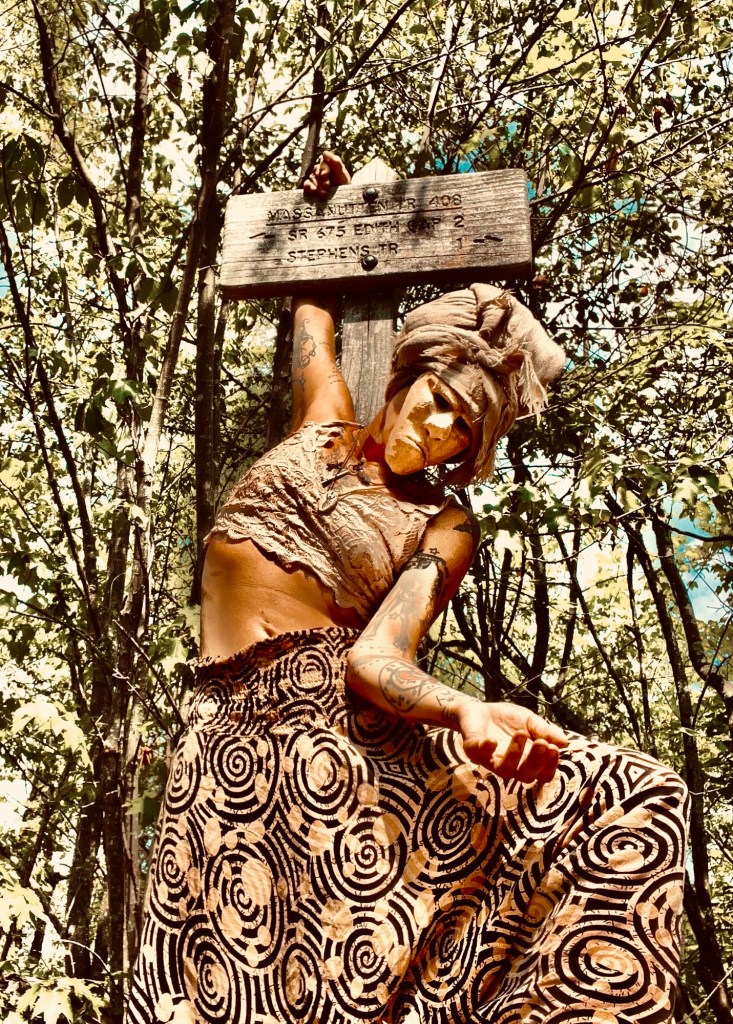
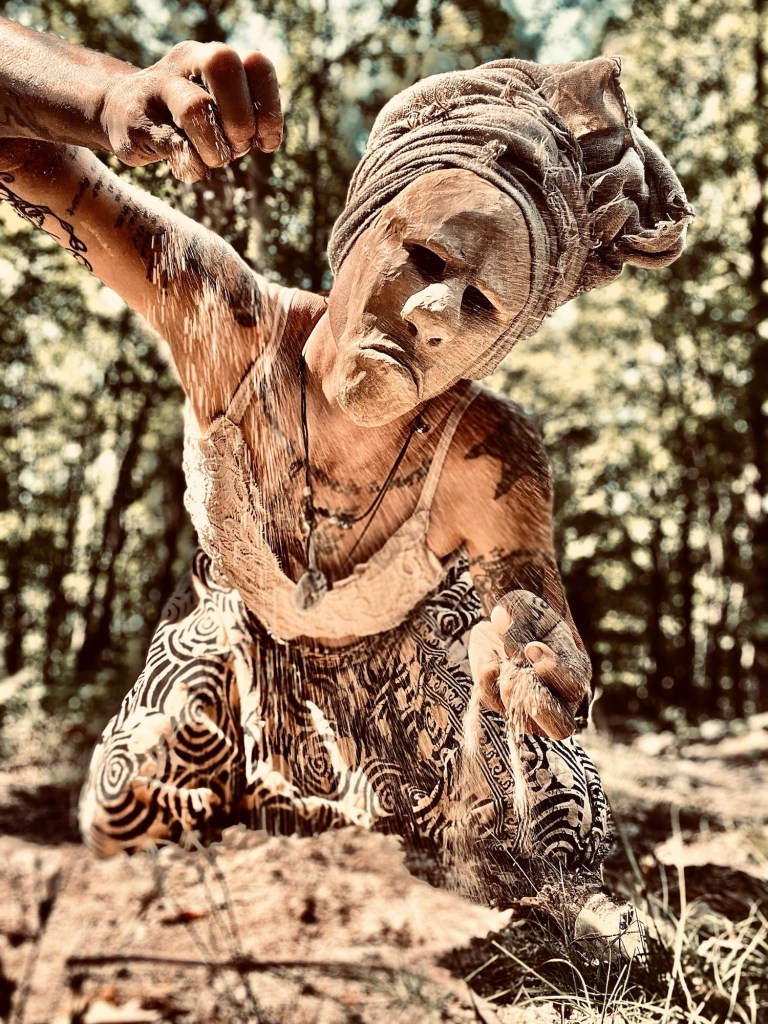
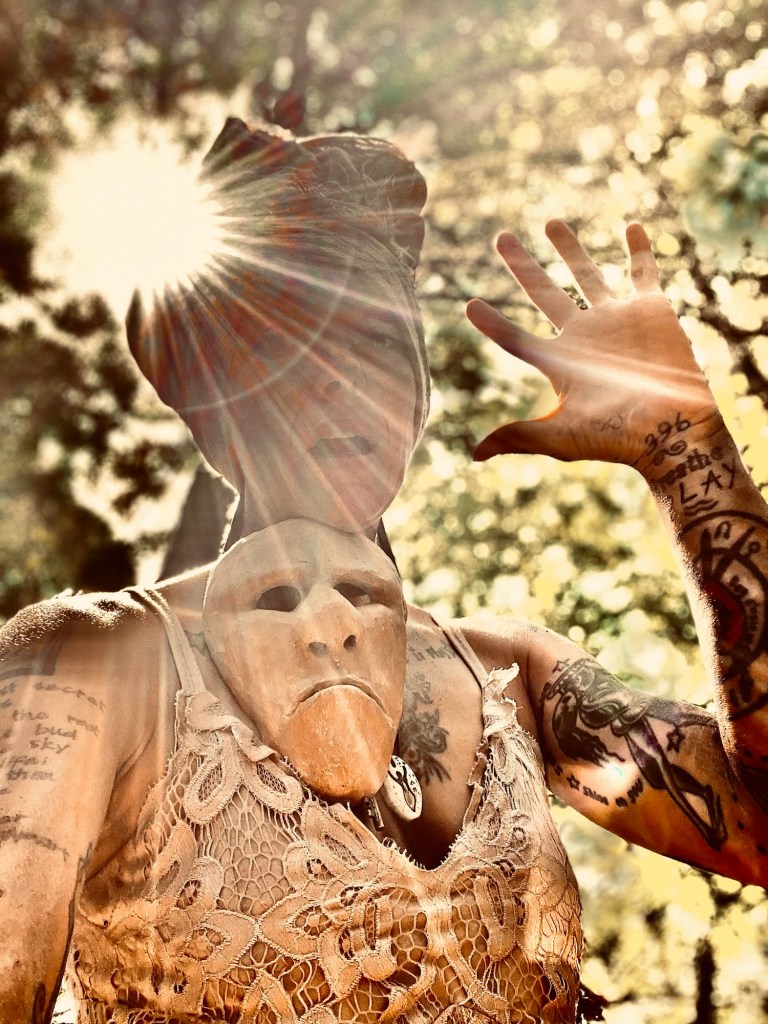
{self Portrait series part 3 : 8-6-24}
“The poeisis of space In this chaotic time Of birth” ~Charleen Johnston
What door is opened into soul through our wounds.
James HillmanThe cure of the shadow is on the one hand a moral problem, that is, recognition of what we have repressed, how we perform our repressions, how we rationalize and deceive ourselves, what sort of goals we have and what we have hurt, even maimed, in the name of these goals. On the other hand, the cure of the shadow is a problem of love. How far can our love extend to the broken and ruined parts of ourselves, the disgusting and perverse? How much charity and compassion have we for our own weakness and sickness?… Loving oneself is no easy matter just because it means loving all of oneself, including the shadow where one is inferior and socially so unacceptable. The care one gives this humiliating part is also the cure. More: as the cure depends on care, so does caring sometimes mean nothing more than carrying.
James Hillman, Meeting the Shadow: The Hidden Power of the Dark Side of Human NatureFor any one of us, child or adult, the question eclipsing all others is: How does what comes with you to the world find a place in the world? How does my meaning fit with the meanings to which I am asked to conform? What helps growing down?
James Hillman, The Soul’s Code: In Search of Character and CallingThere is more in a human life than our theories of it allow. Sooner or later something seems to call us onto a particular path. You may remember this “something” as a signal moment in childhood when an urge out of nowhere, a fascination, a peculiar turn of events struck like an annunciation: This is what I must do, this is what I’ve got to have. This is who I am.
James Hillman, The Soul’s Code: In Search of Character and CallingBut our task here is not to restore all the invisibles but to discriminate among them by attending to the one that once was called your daimon or genius, sometimes your soul or your fate, and now your acorn.
James Hillman, The Soul’s Code: In Search of Character and CallingAttention does for consciousness what our hands do for our bodies: it grabs hold of nature so that we can change it.
James Hillman, Alchemical Psychology: Uniform Edition of the Writings of James Hillman, Vol. 5For the daimon surprises. It crosses my intentions with its interventions, sometimes with a little twinge of hesitation, sometimes with a quick crush on someone or something. These surprises feel small and irrational; you can brush them aside; yet they also convey a sense of importance, which can make you say afterward: “Fate.
James HillmanIdeas that we do not know we have have us. And then they shape our experiences from behind, unbeknown. Psychology’s job, it seems to me, is to see the subjective, archetypal factor in our sight, before or while looking at facts and events. Other sciences have to pretend to being objective, to be describing things as they are; psychology fortunately is always bound by its psychic limitations and can be spared the pretense of objectivity. In place of the obligation to be objectively factual, it is obliged to be subjectively aware, which becomes possible only if we are willing to have an exhaustive go at the assumptions in our primary notions.
James Hillman, Anima: Anatomy of a Personified NotionThere is more in a human life than our theories of it allow.
James Hillman, The Soul’s Code: In Search of Character and Calling“The work of soul–making is concerned essentially with the evocation of psychological faith, the faith arising from the psyche which shows as faith in the reality of the soul… Psychological faith begins in the love of images, and it flows mainly through the shapes of persons in reveries, fantasies, reflections, and imaginations. Their increasing vivification gives one an increasing conviction of having, and then of being, an interior reality of deep significance transcending one’s personal life….”
James HillmanPsychological faith is reflected in an ego that gives credit to images and turns to them in its darkness. Its trust is in the imagination as the only uncontrovertible reality, directly presented, immediately felt.
James HillmanSoul making, as work on anima through images, offers a way of resolving the dependencies of transference. For it is not the therapist or any actual person whatever who is the keeper of my soul beyond all betrayals, but the archetypal persons of the Gods to whom the anima acts as bridge. The shaping of her amorphous moods, sulfuric passions, bitter resentments, and bubbles of distraction into distinct personalities is the main work of therapeutic analysis or soul-making. Therefore, it works in imagination, with imagination, and for imagination. It discovers and forms a personality by disclosing and shaping the multiple soul personalities out of the primary massa confusa of arguing voices and pushing demands.
From Hillman, James, Re-Visioning Psychology, p. 50This is what I must do, this is what I’ve got to have. This is who I am.
James Hillman, The Soul’s Code: In Search of Character and Calling…you find your genius by looking in the mirror of your life. Your visible image shows your inner truth, so when you’re estimating others, what you see is what you get. It therefore becomes critically important to see generously, or you will get only what you see; to see sharply, so that you discern the mix of traits rather than a generalized lump; and to see deeply into dark shadows, or else you will be deceived.
James Hillman, The Soul’s Code: In Search of Character and CallingAnytime you’re gonna grow, you’re gonna lose something. You’re losing what you’re hanging onto to keep safe. You’re losing habits that you’re comfortable with, you’re losing familiarity.
James HillmanI can no longer be sure whether the psyche is in me or whether I’m in the psyche…
James HillmanEach life is formed by its unique image, an image that is the essence of that life and calls it to a destiny. As the force of fate, this image acts as a personal daimon, an accompanying guide who remembers your calling.
James HillmanThe daimon motivates. It protects. It invents and persists with stubborn fidelity. It resists compromising reasonableness and often forces deviance and oddity upon its keeper, especially when neglected or opposed. It offers comfort and can pull you into its shell, but it cannot abide innocence. It can make the body ill. It is out of step with time, finding all sorts of faults, gaps, and knots in the flow of life – and it prefers them. It has affinities with myth, since it is itself a mythical being and thinks in mythical patterns.
James HillmanIt has much to do with feelings of uniqueness, of grandeur and with the restlessness of the heart, its impatience, its dissatisfaction, its yearning. It needs its share of beauty. It wants to be seen, witnessed, accorded recognition, particularly by the person who is its caretaker. Metaphoric images are its first unlearned language, which provides the poetic basis of mind, making possible communication between all people and all things by means of metaphors.
James HillmanExtraordinary people display calling most evidently…they are extraordinary because their calling comes through so clearly and they are so loyal to it. They serve as exemplars of calling and its strength, and also of keeping faith with its signals.
James HillmanFor centuries we have searched for the right term for this “call”. The Romans named it your ‘genius’; the Greeks, your ‘daimon’; and the Christians your guardian angel. The Romantics, like Keats, said the call came from the heart, and Michelangelo’s intuitive eye saw an image in the heart of the person he was sculpting. The Neoplatonists referred to an imaginal body, the ‘ochema’, that carried you like a vehicle. It was your personal bearer or support. For some it is Lady Luck or Fortuna; for others a genie or jinn, a bad seed or evil genius. In Egypt, it might have been the ‘ka’, or the ‘ba’ with whom you could converse. Among the people we refer to as Eskimos and others who follow shamanistic practices, it is your spirit, your free-soul, your animal-soul, your breath-soul.
James Hillman, The Soul’s Code: In Search of Character and CallingPerception bestows blessing—as the stories sketched in this chapter attempt to demonstrate. Perception brings into being and maintains the being of whatever is perceived; and when perception sees in “the holiness of the Heart’s affections,” again as these stories say, things are revealed that prove the Truth of the Imagination.
James Hillman, The Soul’s Code: In Search of Character and CallingAging is no accident. It is necessary to the human condition, intended by the soul. We become more characteristic of who we are simply by lasting into later years; the older we become, the more our true natures emerge. Thus the final years have a very important purpose: the fulfillment and confirmation of one’s character.
James HillmanTell me what you yearn for and I shall tell you who you are. We are what we reach for, the idealized image that drives our wandering.
James HillmanI like to imagine a person’s psyche to be like a boardinghouse full of characters. The ones who show up regularly and who habitually follow the house rules may not have met other long-term residents who stay behind closed doors, or who only appear at night. An adequate theory of character must make room for character actors, for the stuntmen and animal handlers, for all the figures who play bit parts and produce unexpected acts. They often make the show fateful, or tragic, or farcically absurd.
James HillmanLove alone is not enough. Without imagination, love stales into sentiment, duty, boredom. Relationships fail not because we have stopped loving but because we first stopped imagining.
James Hillman
Anything you attend to carefully can bring blessing.
James Hillman
An individual’s harmony with his or her ‘own deep self’ requires not merely a journey to the interior but a harmonizing with the environmental world.
James HillmanAn individual’s harmony with his or her ‘own deep self’ requires not merely a journey to the interior but a harmonizing with the environmental world.
🌟Rank asked why the artist so often avoids clinical neurosis when he is so much a candidate for it because of his vivid imagination, his openness to the finest and broadest aspects of experience, his isolation from the cultural world-view that satisfies everyone else. The answer is that he takes in the world, but instead of being oppressed by it he reworks it in his own personality and recreates it in the work of art. The neurotic is precisely the one who cannot create—the “artiste-manque,” as Rank so aptly called him. We might say that both the artist and the neurotic bite off more than they can chew, but the artist spews it back out again and chews it over in an objectified way, as an external, active, work project. The neurotic can’t marshal this creative response embodied in a specific work, and so he chokes on his introversions. The artist has similar large-scale introversions, but he uses them as material.🌟
:::🌟Ernest Becker, The Denial of Death
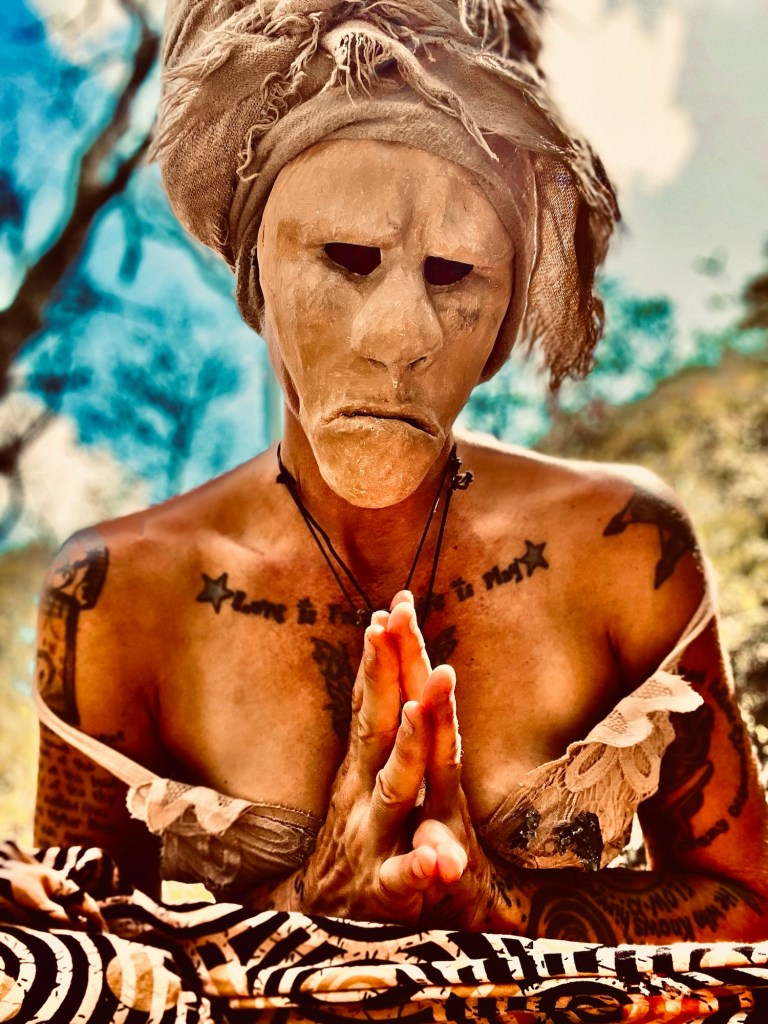
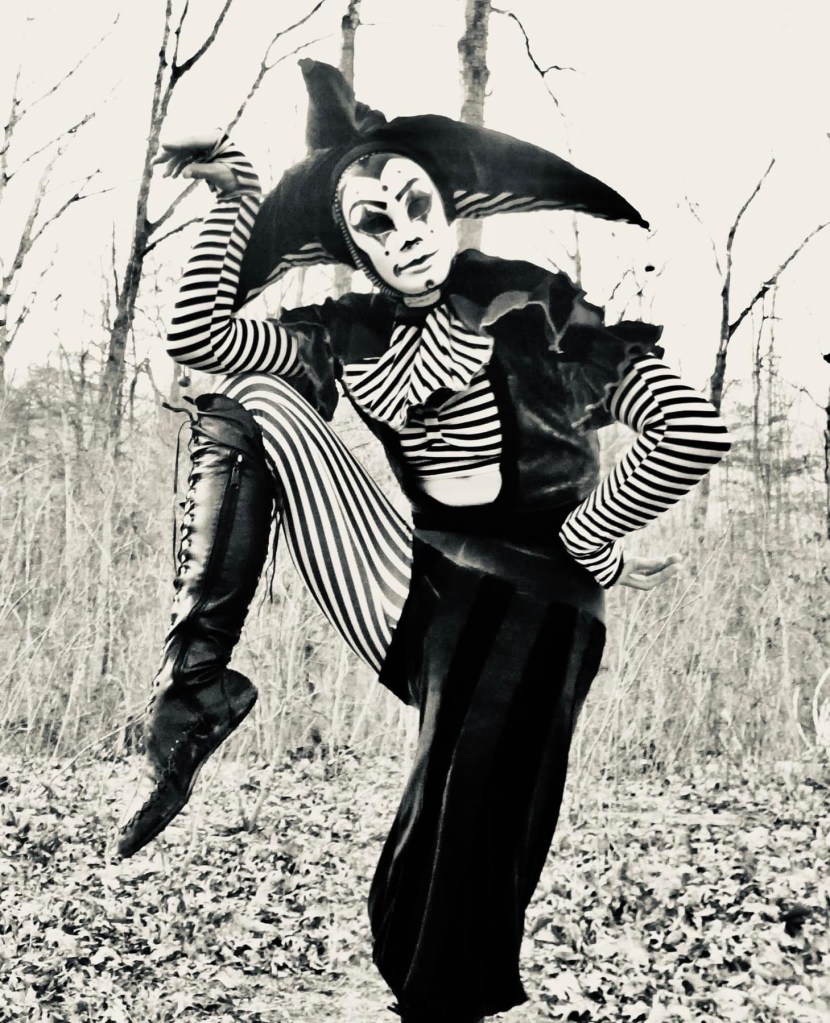
{Self Portrait Series 8-7-24 part 2}
The road to creativity passes so close to the madhouse and often detours or ends there. Ernest Becker, The Denial of DeathMan cannot endure his own littleness unless he can translate it into meaningfulness on the largest possible level.
Ernest Becker, The Denial of DeathThe irony of man’s condition is that the deepest need is to be free of the anxiety of death and annihilation; but it is life itself which awakens it, and so we must shrink from being fully alive.
Ernest Becker, The Denial of DeathThe neurotic exhausts himself not only in self-preoccupations like hypochondrial fears and all sorts of fantasies, but also in others: those around him on whom he is dependent become his therapeutic work project; he takes out his subjective problems on them. But people are not clay to be molded; they have needs and counter-wills of their own. The neurotic’s frustration as a failed artist can’t be remedied by anything but an objective creative work of his own. Another way of looking at it is to say that the more totally one takes in the world as a problem, the more inferior or “bad” one is going to feel inside oneself. He can try to work out this “badness” by striving for perfection, and then the neurotic symptom becomes his “creative” work; or he can try to make himself perfect by means his partner. But it is obvious to us that the only way to work on perfection is in the form of an objective work that is fully under your control and is perfectible in some real ways. Either you eat up yourself and others around you, trying for perfection; or you objectify that imperfection in a work, on which you then unleash your creative powers. In this sense, some kind of objective creativity is the only answer man has to the problem of life. In this way he satisfies nature, which asks that he live and act objectively as a vital animal plunging into the world; but he also satisfies his own distinctive human nature because he plunges in on his own symbolic terms and not as a reflex of the world as given to mere physical sense experience. He takes in the world, makes a total problem out of it, and then gives out a fashioned, human answer to that problem. This, as Goethe saw in Faust, is the highest that man can achieve.
Ernest Becker, The Denial of DeathIn Jung’s terms-that we noted previously-the work is the artist’s own transference projection, and he knows that consciously and critically. Whatever he does he is stuck with himself, can’t get securely outside and beyond himself. He is also stuck with the work of art itself. Like any material achievement it is visible, earthly, impermanent. No matter how great it is, it still pales in some ways next to the transcending majesty of nature; and so it is ambiguous, hardly a solid immortality symbol. In his greatest genius man is still mocked. No matter that historically art and psychosis have had such an intimate relationship, that the road to creativity passes so close to the madhouse and often detours or ends there. The artist and the madman are trapped by their own fabrications; they wallow in their own anality, in their protest that they really are something special in creation.
Ernest Becker, The Denial of DeathThe most that any one of us can seem to do is to fashion something–an object or ourselves–and drop it into the confusion, make an offering of it, so to speak, to the life force.
Ernest Becker, The Denial of DeathGuilt results from unused life, from the unlived in us.
Ernest Becker, The Denial of DeathAnd so we see the paradox that evolution has handed us. If man is the only animal whose consciousness of self gives him an unusual dignity in the animal kingdom, he also pays a tragic price for it. The fact that the child has to identify -first- means that his very first identity is a social product. His habitation of his own body is built from the outside in; not from the inside out. He doesn’t unfold into the world, the world unfolds into him. As the child responds to the vocal symbols learned from his object, he often gives the pathetic impression of being a true social puppet, jerked by alien symbols and sounds. What sensitive parent does not have his satisfaction tinged with sadness as the child repeats with such vital earnestness the little symbols that are taught him?
Ernest Becker, The Birth and Death of Meaning: An Interdisciplinary Perspective on the Problem of ManMan cuts out for himself a manageable world: he throws himself into action uncritically, unthinkingly. He accepts the cultural programming that turns his nose where he is supposed to look; he doesn’t bite the world off in one piece as a giant would, but in small manageable pieces, as a beaver does. He uses all kinds of techniques, which we call the “character defenses”: he learns not to expose himself, not to stand out; he learns to embed himself in other-power, both of concrete persons and of things and cultural commands; the result is that he comes to exist in the imagined infallibility of the world around him. He doesn’t have to have fears when his feet are solidly mired and his life mapped out in a ready-made maze. All he has to do is to plunge ahead in a compulsive style of drivenness in the “ways of the world.
Ernest Becker, The Denial of Death[Man] literally drives himself into a blind obliviousness with social games, psychological tricks, personal preoccupations so far removed from the reality of his situation that they are forms of madness, but madness all the same.
Ernest Becker, The Denial of DeathTo grow up at all is to conceal the mass of internal scar tissue that throbs in our dreams.
Ernest Becker, The Denial of DeathBy the time the child grows up, the inverted search for a personal existence through perversity gets set in an individual mold, and it becomes more secret. It has to be secret because the community won’t stand for the attempt by people to wholly individualize themselves. If there is going to be a victory over human incompleteness and limitation, it has to be a social project and not an individual one. Society wants to be the one to decide how people are to transcend death; it will tolerate the causa-sui project only if it fits into the standard social project. Otherwise there is the alarm of “Anarchy!” This is one of the reasons for bigotry and censorship of all kinds over personal morality: people fear that the standard morality will be undermined-another way of saying that they fear they will no longer be able to control life and death. A person is said to be “socialized” precisely when he accepts to “sublimate” the body-sexual character of his Oedipal project. Now these euphemisms mean usually that he accepts to work on becoming the father of himself by abandoning his own project and by giving it over to “The Fathers.” The castration complex has done its work, and one submits to “social reality”; he can now deflate his own desires and claims and can play it safe in the world of the powerful elders. He can even give his body over to the tribe, the state, the embracing magic umbrella of the elders and their symbols; that way it will no longer be a dangerous negation for him. But there is no real difference between a childish impossibility and an adult one; the only thing that the person achieves is a practiced self-deceit-what we call the “mature” character.
Ernest Becker, The Denial of DeathThe ironic thing about the narrowing-down of neurosis is that the person seeks to avoid death, but he does it by killing off so much of himself and so large a spectrum of his action-world that he is actually isolating and diminishing himself and becomes as though dead. There is just no way for the living creature to avoid life and death, and it is probably poetic justice that if he tries too hard to do so he destroys himself.
Ernest Becker, The Denial of DeathKierkegaard gives us some portrait sketches of the styles of denying possibility, or the lies of character-which is the same thing. He is intent on describing what we today call “inauthentic” men, men who avoid developing their own uniqueness; they follow out the styles of automatic and uncritical living in which they were conditioned as children. They are “inauthentic” in that they do not belong to themselves, are not “their own” person, do not act from their own center, do not see reality on its terms; they are the one-dimensional men totally immersed in the fictional games being played in their society, unable to transcend their social conditioning: the corporation men in the West, the bureaucrats in the East, the tribal men locked up in tradition-man everywhere who doesn’t understand what it means to think for himself and who, if he did, would shrink back at the idea of such audacity and exposure.
Ernest Becker, The Denial of DeathAnthropologists have long known that when a tribe of people lose their feeling that their way of life is worth-while they may stop reproducing, or in large numbers simply lie down and die beside streams full of fish: food is not the primary nourishment of man.
Ernest Becker, The Birth and Death of Meaning: An Interdisciplinary Perspective on the Problem of ManBeyond a given point man is not helped by more “knowing,” but only by living and doing in a partly self-forgetful way. As Goethe put it, we must plunge into experience and then reflect on the meaning of it. All reflection and no plunging drives us mad; all plunging and no reflection, and we are brutes.
Ernest Becker, The Denial of DeathTake stock of those around you and you will … hear them talk in precise terms about themselves and their surroundings, which would seem to point to them having ideas on the matter. But start to analyse those ideas and you will find that they hardly reflect in any way the reality to which they appear to refer, and if you go deeper you will discover that there is not even an attempt to adjust the ideas to this reality. Quite the contrary: through these notions the individual is trying to cut off any personal vision of reality, of his own very life. For life is at the start a chaos in which one is lost. The individual suspects this, but he is frightened at finding himself face to face with this terrible reality, and tries to cover it over with a curtain of fantasy, where everything is clear. It does not worry him that his “ideas” are not true, he uses them as trenches for the defense of his existence, as scarecrows to frighten away reality.
Ernest Becker, The Denial of DeathThe man of knowledge in our time is bowed down under a burden he never imagined he would ever have: the overproduction of truth that cannot be consumed.
Ernest Becker, The Denial of DeathThere is no doubt that creative work is itself done under a compulsion often indistinguishable from a purely clinical obsession. In this sense, what we call a creative gift is merely the social license to be obsessed. And what we call “cultural routine” is a similar license: the proletariat demands the obsession of work in order to keep from going crazy. I used to wonder how people could stand the really demonic activity of working behind those hellish ranges in hotel kitchens, the frantic whirl of waiting on a dozen tables at one time, the madness of the travel agent’s office at the height of the tourist season, or the torture of working with a jack-hammer all day on a hot summer street. The answer is so simple that it eludes us: the craziness of these activities is exactly that of the human condition. They are “right” for us because the alternative is natural desperation. The daily madness of these jobs is a repeated vaccination against the madness of the asylum. Look at the joy and eagerness with which workers return from vacation to their compulsive routines. They plunge into their work with equanimity and lightheartedness because it drowns out something more ominous.
Ernest Becker, The Denial of DeathIn other words, as long as man is an ambiguous creature he can never banish anxiety; what he can do instead is to use anxiety as an eternal spring for growth into new dimensions of thought and trust. Faith poses a new life task, the adventure in openness to a multi-dimensional reality.
Ernest Becker, The Denial of DeathPeople create the reality they need in order to discover themselves.
Ernest Becker, The Denial of DeathThe “healthy” person, the true individual, the self-realized soul, the “real” man, is the one who has transcended himself.
Ernest Becker, The Denial of DeathThe great boon of repression is that it makes it possible to live decisively in an overwhelmingly miraculous and incomprehensible world, a world so full of beauty, majesty, and terror that if animals perceived it all they would be paralyzed to act. … What would the average man (sic) do with a full consciousness of absurdity? He has fashioned his character for the precise purpose of putting it between himself and the facts of life; it is his special tour-de-force that allows him to ignore incongruities, to nourish himself on impossibilities, to thrive on blindness. He accomplishes thereby a peculiarly human victory: the ability to be smug about terror.
Ernest Becker, The Denial of DeathTake the average man who has to stage in his own way the life drama of his own worth and significance. As a youth he, like everyone else, feels that deep down he has a special talent, an indefinable but real something to contribute to the richness and success of life in the universe. But, like almost everyone else, he doesn’t seem to hit on the unfolding of this special something; his life takes on the character of a series of accidents and encounters that carry him along, willy-nilly, into new experiences and responsibilities. Career, marriage, family, approaching old age – all these happen to him, he doesn’t command them. Instead of his staging the drama of his own significance, he himself is staged, programmed by the standard scenario laid down by his society.
Ernest Becker, Angel in Armor: A Post-Freudian Perspective on the Nature of ManSecrets and silences make life more real: the individual, self-absorbed and inwardly musing, taking himself very seriously, radiates a contagious aura: the tacit communication that the serious and the meaningful exist.
Ernest Becker, The Birth and Death of Meaning: An Interdisciplinary Perspective on the Problem of ManKierkegaard put it this way: But while one sort of despair plunges wildly into the infinite and loses itself, a second sort permits itself as it were to be defrauded by “the others.” By seeing the multitude of men about it, by getting engaged in all sorts of wordly affairs, by becoming wise about how things go in this world, such a man forgets himself… does not dare to believe in himself, finds it too venturesome a thing to be himself, far easier and safer to be like the others, to become an imitation, a number, a cipher in the crowd.
Ernest Becker, The Denial of DeathWe fear our highest possibility (as well as our lowest ones). We are generally afraid to become that which we can glimpse in our most perfect moments…. We enjoy and even thrill to the godlike possibilities we see in ourselves in such peak moments. And yet we simultaneously shiver with weakness, awe and fear before these very same possibilities.
🌟🌟🌟 “Creativity is divine! To me it is the virgin soul opening to spirit and creating the divine child. You cannot live without it. That’s the meaning of life, that creative fire………::”
“::….. My soul is fed. I see, I smell, I taste, I hear, I touch. Through the orifices of my body, I give and I receive. I am not trying to capture what is absent. It’s that interchange between the embodied soul and the outside world that is the dynamic process. That’s how growth takes place. That is life.”🌟🌟🌟
Marion Woodman
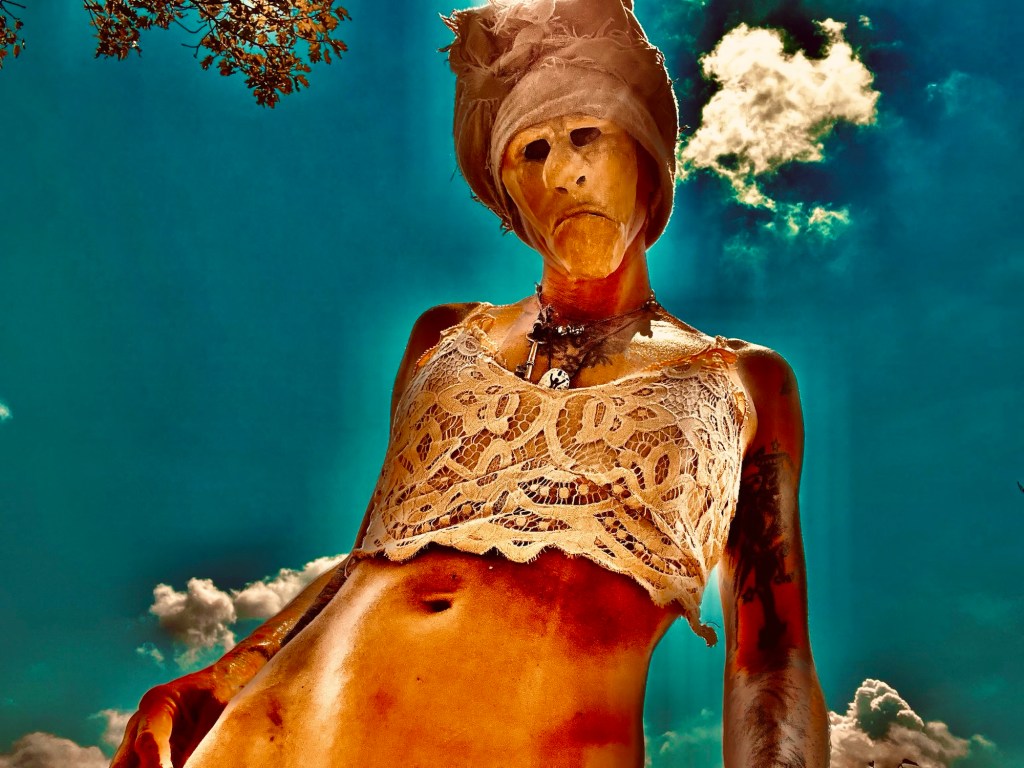
{self Portrait series at Kennedy peak 8-6-24}
This is your body, your greatest gift, pregnant with wisdom you do not hear, grief you thought was forgotten, and joy you have never known. Marion WoodmanTo me, real love, the move from power to love, involves immense suffering. Any creative work comes from that level, where we share our sufferings, just the sheer suffering of being human. And that’s where the real love is. Marion WoodmanWhen the power comes from within us and we claim it as our own, then we no longer have to affirm ourselves by dominating others. The irony is that we are actually afraid of our own power.
Marion Woodman, Dancing in the Flames: The Dark Goddess in the Transformation of ConsciousnessOnly by discovering and loving the goddess lost within our rejected body can we hear our own authentic voice.
Marion Woodman, Coming Home to Myself: Reflections for Nurturing a Woman’s Body and SoulI yearned for lightness; I still yearn for lightness. Lightness is freedom — freedom from the heaviness of too much stuff, too many words, too heavy a pull toward inertia. I feared being buried in stone — becoming stone.
Marion Woodman, Bone: Dying into LifeKill the imagination and you kill the soul. Kill the soul and you’re left with a listless, apathetic creature who can become hopeless or brutal or both.
Marion Woodman, Bone: Dying into LifeIn our yearning to be perfect, we have mistaken perfection for wholeness. We think we cannot love ourselves until we and others meet some external standard. Depression, anxiety—in fact, most neuroses and compulsions—are ultimately a defense against loving ourselves without condition. We are afraid to look at the damp, dark, ugly yet exquisite roots of being that stretch deep into our survival chakra. We are fearful of finding that the spirit is not there, that our Home is empty, even as our outer home is empty. Yet it is in that place of survival, where the dark mother has been abandoned, that spirit longs to be embodied so that the whole body may become light. Ego wants to be the god of our own idealized projection; spirit wants to be incarnated in our humanity where it can grow in wisdom through experience.
Marion Woodman, Dancing in the Flames: The Dark Goddess in the Transformation of ConsciousnessThe Goddess is the unspeakable wisdom that grows into the very cells of the body. She lives with this sacramental truth at her center: the beauty and the horror of the whole of life are blazing in Her love. She is dancing in the flames.
Marion Woodman, Dancing in the Flames: The Dark Goddess in the Transformation of ConsciousnessIn the story of Persephone and Hades there is a child. Hades abducts Persephone and takes her into the Underworld, where in some versions of the myth she has a child. In many of the myths, Leda and the swan, Danae and the shower of gold, for example, the human woman is impregnated by the god. In other words, matter is penetrated by spirit and the child of the union of matter and spirit is the divine child.
Marion WoodmanYou think of yourself — light, fast, free — free of earth, free of bondage to your body. In your ‘perfect’ body, you are in control, addicted to the light that keeps you out of body. You’re a swan maiden, addicted to wings, addicted to spirit. You refused to eat in order to fly.
Marion Woodman, Bone: Dying into LifeThe solid line throughout was my trying to make space to fly and forever smashing my wings against the bars of the cage. Granted, the cage grew bigger and very big, but I was always beyond the collective in my soul and always cut back by the collective in my body.
Marion Woodman, Bone: Dying into LifeThe word ‘feminine,’ as I understand it, has very little to do with gender, nor is woman the custodian of femininity. Both men and women are searching for their pregnant virgin. She is the part of us who is outcast, the part who comes to consciousness through going into darkness, mining our leaden darkness, until we bring her silver out.
Marion Woodman, The Pregnant Virgin: A Process of Psychological TransformationWhy put them through the danger of the fire? And then, I heard, as though it spoke, the voice of the guardian-head: “Each piece must go through the fire. The cowl, the wings, the pneuma, the source, the flow. All must go the way that I have gone. Each may crack in the process, as I have cracked. But look, the crack has healed. I did not break. Without the fire, the piece is untested, unlived, raw. Each must go through the fire.
Marion Woodman, Leaving My Father’s House: A Journey to Conscious FemininityKundalini power, the symbol of raising the energy coiled at the base of the spine upward through the chakras, is called by Sri Chinmoy, ‘the power of the Supreme Goddess.’ Repressed or coiled in a circle, she can be poisonous both to the body and the psyche, but once risen and standing upright, she is beneficent. The power of the serpent, rightly understood, is one of the ways the Goddess overcomes duality.
Marion Woodman, Dancing in the Flames: The Dark Goddess in the Transformation of ConsciousnessSo long as she is obedient to a mother—actual or internal—who unconsciously wishes to annihilate her, she is in a state of possession by the witch; she will have to differentiate herself out from that witch in order to live her own life.
Marion Woodman, Addiction to Perfection: The Still Unravished Bride: A Psychological StudyThe way to healing an addiction lies in finding a connection between body and soul.
Marion Woodman, Coming Home to Myself: Reflections for Nurturing a Woman’s Body and SoulIf we are blindly living out an archetype, we are not containing our own life. We are possessed, and possession acts as a magnet on unconscious people in our environment. A life that is being truly lived is constantly burning away the veils of illusion, gradually revealing the essence of the individual.
Marion Woodman, The Pregnant Virgin: A Process of Psychological TransformationMany people are being dragged toward wholeness in their daily lives, but because they do not understand initiation rites, they cannot make sense of what is happening to them. They are being presented with the possibility of rebirth into a different life. Through failures, symptoms, inferiority feelings and overwhelming problems, they are being prodded to renounce life attachments that have become redundant. The possibility of rebirth constellates with the breakdown of what has gone before. But because they do not understand, people cling to the familiar, refuse to make the necessary sacrifices, resist their own growth. Unable to give up their habitual lives, they are unable to receive new life. Unless cultural rituals support the leap from one level of consciousness to another, there are no containing walls within which the process can happen. Without an understanding of myth or religion, without an understanding of the relationship between destruction and creation, death and rebirth, the individual suffers the mysteries of life as meaningless mayhem—alone.
Marion Woodman, The Pregnant Virgin: A Process of Psychological TransformationWhat I learned is the difference between of destiny and fate. We are all fated to die. Destiny is recognizing the radiance of the soul that, even when faced with human impossibility, loves all of life. Fate is the death we owe to Nature. Destiny is the life we own to soul.
Marion Woodman, Bone: Dying into LifeLinearity does not come naturally to me. It kills my imagination. Nothing happens. No bell rings. No moment of here and now. No moment that says yes. Without these, I am not alive. I prefer the pleasure of the journey through the spiral. Relax. Enjoy the spiral. If you miss something on the first round, don’t worry. You might pick it up on the second—or third—or ninth. It doesn’t matter. Relax. Timing is everything. If the bell does ring, it will resonate through all the rungs of your spiral. If it doesn’t ring, it is the wrong spiral— or the wrong time— or there is no bell.
Marion Woodman, Coming Home to Myself: Reflections for Nurturing a Woman’s Body and SoulA free woman has a strong neck—an open connection between heart and head, a balance between reality and ideals. To fall into the complex is to damn herself for her imperfections; to accept the attitude of the virgin is to accept her human life and open herself to her own truth.
Marion WoodmanWithout embodied soul, spirit cannot manifest through human feeling.
Marion Woodman, The Ravaged Bridegroom: Masculinity in WomenWhether we like it or not, one of our tasks on this earth is to work with the opposites through different levels of consciousness until body, soul and spirit resonate together. Initiation rites, experienced at the appropriate times in our lives, burn off what is no longer relevant, opening our eyes to new possibilities of our own uniqueness. They tear off the protective veils of illusion until at last we are strong enough to stand in our own naked truth.
Marion Woodman, The Pregnant Virgin: A Process of Psychological TransformationA woman must be able to stand in the face of power, because ultimately some part of that power will become hers.
Clarissa Pinkola Estés, Women Who Run With the WolvesThis is your body, your greatest gift, pregnant with wisdom you do not hear, grief you thought was forgotten, and joy you have never known.
Marion WoodmanSo long as consciousness is enslaved by the darkness of unconsciousness, we blindly live out these handicaps in our lives, projecting them onto our men or choosing defeated men as an image of our own defeat. The flames of our fear, grief and rage burn without light. Without realizing what we are doing, we can allow consciousness to fall into the service of darkness. If, on the other hand, we are conscious of the darkness, that very consciousness is the light that illumines the darkness. This is the journey into mature consciousness, with arms and legs, heart and genitals, strong enough to bear the lights.
Marion Woodman, The Ravaged Bridegroom: Masculinity in WomenLiving by principles is not living your own life. It is easier to try to be better than you are than to be who you are.
Marion Woodman, Addiction to Perfection: The Still Unravished Bride:William Blake says the body is ‘that portion of soul discerned by the five senses.
Marion Woodman, Conscious Femininity: Interviews With Marion WoodmanLove is the real power. It’s the energy that cherishes. The more you work with that energy, the more you will see how people respond naturally to it, and the more you will want to use it. It brings out your creativity, and helps everyone around you flower. Your children, the people you work with–everyone blooms.
Marion WoodmanThe Crone has been missing from our culture for so long that many women, particularly young girls, know nothing of her tutelage. Young girls in our society are not initiated by older women into womanhood with its accompanying dignity and power. Without the Crone, the task of belonging to oneself, of being a whole person, is virtually impossible.
Marion Woodman, Dancing in the Flames: The Dark Goddess in the Transformation of ConsciousnessWomen are, by nature, disposed to relationship and connectedness; yet true relationship cannot be embraced until a woman as a deep sense of her at-one-ment. Without this essential independence from all roles and bonds, she is a potential victim for servitude.
Marion Woodman, Dancing in the Flames: The Dark Goddess in the Transformation of ConsciousnessShe dreams she is in a glass coffin. From her prison, details have beauty. In her aloneness, she imagines emotions. Her husband is the perfect bridegroom, the trickster, the small boy looking for mother. She is goddess and mirror, siren and friend, femme fatale and sacrificing wife. He is attracted to her girlhood purity, her desire to sacrifice, to serve. At first he may be flattered: she sees him as a god.
Marion Woodman, Coming Home to Myself: Reflections for Nurturing a Woman’s Body & SoulSince she has not been present in the culture, she has not been readily accessible to the conscious awareness of modern women. Without her, even the dynamic symbols of Virgin and Mother are distorted. The Crone is a woman is that part of her psyche that is not identified with any relationship nor confined by any bond. She infuses an intrinsic sense of self-worth, of autonomy, into the role of virgin and mother, and gives the woman strength to stand to her own creative experience.
Marion Woodman, Dancing in the Flames: The Dark Goddess in the Transformation of ConsciousnessCan I really believe I am worth an hour a day? Am I, who have given my life to others, selfish enough to take one hour a day to find myself?
Marion Woodman, Coming Home to Myself: Reflections for Nurturing a Woman’s Body & SoulChange means change. We may have all the insights, but if we do not incarnate them, they are all in vain.
Marion Woodman, Dancing in the Flames: The Dark Goddess in the Transformation of ConsciousnessWe know we can change ourselves when we realize that we are not dependent on how we feel, nor on how others feel about us, nor on what the situation is around us. The values we hold, the choices we make within ourselves and for iourselves remain our prerogative. In most situations, if we begin to change, to do our own inner work, to accept our own darkness and work toward consciousness, the situation will change. We will begin to emanate a different energy, one that exudes a sense of autonomy and authenticity.
Marion Woodman, Dancing in the Flames: The Dark Goddess in the Transformation of ConsciousnessIt takes great courage to break with one’s past history and stand alone
Marion WoodmanOnce the purging has taken place, the woman often dreams of a black goddess who becomes her bridge between spirit and body. As one aspect of Sophia, such an image can open her to the mystery of life being enacted in her own body. Her “mysterious and exotic darkness” inspires a particular depth of wonderment and love. For a woman without a positive mother, this “dark” side of the Virgin can bring freedom, the security of freedom, because she is a natural home for the rejected child. The child born from the rejected side of the mother can bring her own rebel to rest in the outcast state of Mary. In loving the abandoned child within herself, a woman becomes pregnant with herself. The child her mother did not nourish, she will now nourish, not as the pure white biblical Virgin who knew no Joseph, but as the dark Montserrat Virgin who presides over “marriage and sex, pregnancy and childbirth.” The Black Madonna is nature impregnated by spirit, accepting the human body as the chalice of the spirit. She is the redemption of matter, the intersection of sexuality and spirituality.
Marion WoodmanWe are all unconsciously bound to the wheel of fortune. It goes round and round and we go blindly around on it until one day something happens that wakes us up, face to face with ourselves. What for years we could not or would not see is made visible. The unconscious is made answerable to consciousness. The Self demands a reckoning: the ego must recognize what it has long feared and rejected. Whether we grow or wither in that encounter depends on whether we cling to our ego’s rigid standpoint or whether we choose to trust the Self and leap into the unknown.
Marion Woodman, The Ravaged Bridegroom: Masculinity in Women
🔥 In contrast, archetypal psychology holds that the true iconoclast is the image itself which explodes its allegorical meanings, releasing startling new insights. Thus the most distressing images in dreams and fantasies, those we shy from for their disgusting distortion and perversion, are precisely the ones that break the allegorical frame of what we think we know about this person or that, this trait of ourselves or that. The “worst” images are thus the best, for they are the ones that restore a figure to its pristine power as a numinous person at work in the soul…
….A more general result of nominalism is “logophobia,” a dread of words especially of big words which might harbor irrealities. Our difficulty with the word archetype and with envisioning the reality of archetypal images and ideas is one of the effects of nominalism. We are in peculiar double bind with words; they fascinate and at the same time repel. For because of nominalism words have become both bloated in importance and dried in content. In the modern language-games of Wittgenstein, words are the very fundamentals of conscious existence, yet they are also severed from things and from truth. They exist in a world of their own. In modern structural linguistics, words have no inherent sense, for they can be reduced, every single one of them, to basic quasi-mathematical units. The fantasy of a basic number of irreducible elements out of which all speech can be constituted is a dissecting technique of the analytic mind which applies logical atomism to Logos itself–a suicide of the word.
Of course there is a credibility gap, since we no longer trust words of any sort as true carriers of meaning. Of course, in psychiatry, words have become schizogenic, themselves a cause and source of mental disease. Of course we live in a world of slogan, jargon, and press releases, approximating the “Newspeak” of Orwell’s 1984.
As one art and academic field after another falls into the paralyzing coils of obsession with language and communication, speech succumbs to a new semantic anxiety. Even psychotherapy, which began as a “talking cure” – ‘ the rediscovery of the oral tradition of telling one’s story- is abandoning language for touch, cry, and gesture. We dare not be eloquent. To be passionate, psychotherapy now says we must be physical or primitive. Such psychotherapy promotes a new barbarism. Our semantic anxiety has made us forget that words, too, burn and become flesh as we speak.
A new angelology of words is needed so that we may once again have faith in them. Without the inherence of the angel in the word- and angel means originally “’emissary, “‘message-bearer” -how can we utter anything but personal opinions, things made up in our subjective minds? How can anything of worth and soul be conveyed from one psyche to another, as in a conversation, a letter, or a book, if archetypal significances are not carried in the depths of our words?
We need to recall the angel aspect of the word, recognizing words as independent carriers of soul between people. We need to recall that we do not just make words up or learn them in school, or ever have them fully under control. Words, like angels, are powers which have Invisible power over us. They are personal presences which have whole mythologies: genders, genealogies (etymologies concerning origins and creations), histories, and vogues; and their own guarding, blaspheming, creating, and annihilating effects. For words are persons. This aspect of the word transcends their nominalistic definitions and contexts and evokes in our souls a universal resonance. Without the inherence of soul In words, speech would not move us, words would not provide forms for carrying our lives and giving sense to our deaths. “Death” itself, and “soul” “Gods,” “persons, would become, as Antiphon the Sophist said thousands of years ago, mere conventions and artifacts.’ Personifying would be simply a manner of nominalistic speech.
It is this person in the word, its angelic power, that nominalism dreads. Nominalism is not simply a philosophical position which would disembowel words, emptying them into windbags, fatus voci. It is a psychological defense against the psychic component of the word. The bigness it fears and would reduce refers to the complex nature of words which act upon us as complexes and release complexes in us. Philosophy works wholly with words, so it must bring their complexities into rational order. This is the job of rational speech whether in logic, theology, or science. In fact, rational use of words was what the word “sanity” originally meant in Latin. Therefore, nominalism refuses to recognize the person in the word or to personify them; to do so implies insanity.
I admit that the personifying path we are on is, indeed, deviant if not mad. But it is from this psychological perspective that we must look at all judgments against personifying. For these judgments come from a tradition that has progressively depotentiated both images and words in order to maintain a particular vision of man, reason, and reality. This vision divides the world into objects and egos, giving to the soul no more place than the pea-sized pineal gland, to which island in the middle of the brain Descartes banished the psyche at the beginning of our modern period….🔥
🌜✨🌟….Anthropomorphism, the attribution of human form and character …..ascription of a human attribute of personality to anything impersonal or 'irrational" enters the English language in 1793 via the French. Animism , the attribution of a living soul to inanimate objects and natural phenomena “, occurs a century later in the present sense made familiar by the anthropologist Tylor's Primitive Culture (1871). The first is an emissary into English of the French Enlightenment with its acute sensitiveness to the irrationality of religion and its investment in the Cartesian world of dead and impersonal objects. The second is a product of Victorian progressive scientism. Both are heritages of nominalism. Both deprive that mode of experience to which they purportedly refer of its native validity. So we shall not use the terms anthropomorphism and animism but rather the term personifying to signify the basic psychological activity- the spontaneous experiencing envisioning and speaking of the configurations of existence as psychic presences- and hopefully thereby save this authentic activity from being condemned as personification.
Personification is a psychologism. It implies a human being who creates Gods in human likeness much as an author creates characten out of his own personality. These Gods depict his own needs; they are his projections. Personification cannot imagine that these psychic presences (Gods, daemons, and other persons of the mythical realm) have autonomous substantial reality. It cannot imagine that an author, say, is driven to bear the messages of "his" characters, that it is their will that is done, that he is their scribe, and that they are creating him even while he creates them. An author's fictions are often more significant than his own reality, containing more psychic substance, which lasts long after their "creator" has gone. An author creates only by their authority. The notion that literary fictions have an inherent autonomy is itself visioned by means of a personified Muse, without whose aid the entire writing venture becomes precarious.
All three terms- anthropomorphism, animism, personification - contain one basic idea: there exists a “mode of thought” which takes an inside event and puts it outside, at the same time making this content alive, personal, and even divine. These three terms by saying that human beings tend to imagine things into souls, are actually describing a manner of soul-making. But by calling this activity a "mode of thought" it becomes an act we perform- conscious or unconscious- rather than something we immediately experience. Where these three terms assume thought makes soul, personifying recognizes soul as existent prior to reflection. Personifying is a way of being in the world and experiencing the world as a psychological field, where persons are given with events, so that events are experiences that touch us, move us, appeal to us.
But as Van der Leeuw has said we waste breath trying to disprove the theory of animism. It can, however, be seen through as a psychological statement saying less about the soul of primitives than about the primitive soul of those writing about them. Animism is an anthropological report about the soul of anthropology. “In its entire structure and tendency," says van der Leeuw, “this theory suits the second half of the nineteenth century far better than it does the primitive world."
The theory of animism represents a condition of soul (anima) which cannot find soul except as projected into infantile behavior, psychopathology of fetishism, the common people of the collective mind, or the dark places and peculiar behaviors of exotic peoples in distant islands or insane asylums. Through these concepts —personification, anthropomorphism, animism-- reason could indeed make stones live again and even create souls and Gods. The rational tradition, having lost its base in the psyche, was trying to Rediscover it through the anthropology of animism. “ 🌟✨🌛
🔥🃏🔥 But there was another tradition, which continued to regard personifying as a necessary mode of understanding the world and of being in it It began with the Greeks and Romans, who personified such psychic powers as Fame, Insolence, Night, Ugliness, Timing, Hope, to name but a few. These were regarded as “real daemons to be worshipped and propitiated and no mere figments of the imagination. And, as is well known, they were actually worshipped in every Greek city. To mention Athens alone, we find altars and sanctuaries of Victory, Fortune, Friendship, Forgetfulness, Modesty, Mercy, Peace, and many more.
Many consider this practice as merely animistic, but it was really an act of ensouling; for there is no question that the personifying of the ancient Greeks and Romans provided altars for configurations of the soul. When these are not provided for, when these Gods and daemons are not given their proper place and recognition, they become diseases -a point Jung made often enough. The need to provide containers for the many configurations of the soul was formulated in the third century A.D. by the greatest of all Platonist philosophers, Plotinus. In a section of his Enneads called appropriately "The Problems of the Soul" we find this passage:
~”I think, therefore, that those ancient sages, who sought to secure the presence of divine beings by the erection of shrines and statues, showed insight into the nature of the All; they perceived that, though this soul is everywhere tractable, its presence will be secured all the more readilywhen an appropriate receptacie is elaborated, a place especially capable of receiving some portion or phase of it, something reproducing it, or representing it and serving like a mirror to catch an image of it.”~
When in the next passage (IV, 3, 12) he speaks of "the souls of men, seeing their images in the mirror of Dionysus," he seems again to be referring to the ability of the soul to divide into many parts, and that its portions and phases reflect the various images of divine persons. Personifying not only aids discrimination; it also offers another avenue of loving, of imagining things in a personal form so that we can find access to them with our hearts. Words with capital letters are charged with affect, they jump out of their sentences and become images. The tradition of depersonifying recognized full well that personified words tend to become cherished and sacred, affecting the reason of the heart. Hence nominalists disparage the personified style of expression, calling it rhetoric with emotive meaning only. But this very recognition, that personifying emotionalizes, shift the discussion from nominalism to imagination, from head to heart.
The image of the heart- “l'immagine del cuor"- was an important idea in the work of Michelangelo who was strongly influenced by the Platonist tradition. Imagining with the heart refers to a mode of perception that penetrates through names and physical appearances to a personified interior image, from the heart to the heart. When Michelangelo portrayed Lorenzo and Giuliano Medici in the Sacristy of Sen Lorenzo, the features which he depicted were unnatural, not as they appeared in life but rather transfigured to conform with the true image of their persons in the heart. While the scientific Renaissance (Bacon and Galileo) insisted on the primacy of sense perception, Michelangelo’s “imagine del cuor" implied that perception is secondary to imagination. By imagining through and beyond what the eye see, the imagination envisions primordial images. And these present themselves in personified forms.
Nearer our own times another Mediterranean, the Spaniard Miguel de Unamuno (b. 1864), returned to the relationship of heart and personified images and explained the necessary interdependence between love and personifying:
~”In order to love everything, in order to pity everything, human and extra-human, living and non-living, you must feel everything within yourself, you must personalize everything. For everything that it loves, everything that it pities, love personalizes. We only love--that which is like ourselves . . . it is love itself that reveals these resemblances to us. ... Love personalizes all that it loves. Only by personalizing it can we fall in love with an idea.«”
He sums up, saying: "Our feeling of the world, upon which is based our understanding of it, is necessarily anthropomorphic and mythopeic. Loving is a way of knowing, and for loving to know, it must personify. Personifying is thus a way of knowing, especially knowing what is invisible, hidden in the heart. In this perspective personifying is not a lesser, primitive mode of apprehending but a finer one. It presents in psychological theory the attempt to integrate heart into method and to return abstract thoughts and dead matter to their human shapes. Because personifying is an epistemology of the heart, a thought mode of feeling, we do wrong to judge it as inferior, archaic thinking appropriate only to those allowed emotive speech and affective logic- children, madmen, poets, and primitives. Method in psychology must not hinder love from working and we are foolish to decry as inferior the very means by which love understands. If we have not understood personifying, it is because the main tradition has always tried to explain it rather than understand it.
🌀🌟To the mythic perspective the world appears personified, implying a passionate engagement with it. We do not ask: "Are things alive or dead?" or "Are Gods real or are they symbolic projections?" Questions of this sort “may be thought illegitimate," says the most psychological of all classicists, E. R. Dodds, “so long as myth-making is a living mode of thought to confront it with this sort of brutal either-or' is to force upon it a choice which destroys its being. Mythic consciousness answers with Cassirer: "There is nowhere an 'it' as a dead object, a mere thing.'* Subject and object, man and Gods, I and Thou, are not apart and isolated each with a different sort of being, one living or real, the other dead or imaginary. The world and the Gods are dead or alive according to the condition of our souls. A world view that perceives a dead world or declares the Gods to be symbolic projections derives from a perceiving subject who no longer experiences in a personified way, who has lost his ‘immagine del cuor.’
To rekindle this life we start with soul, reimagining its internal processes anthropomorphically.This leads to the ultimate conclusion that we do not actually per sonify at all. Mythical consciousness is a mode of being in the world that brings with it imaginal persons. They are given with the imagination and are its data. Where imagination reigns, personifying happens. We experience it nightly, spontaneously, in dreams. Just as we do not create our dreams, but they happen to us, so we do not invent the persons of myth and religion; they, too, happen to us. The persons present themselves as existing prior to any effort of ours to personify. To mythic consciousness, the persons of the imagination are real. The late German classical scholar who had the deepest insight into the nature of mythical persons, Walter F. Otto, made this same point in an attack against his rationalist and reductive colleagues:
~There is no such thing as personification, only a depersonification--just as there is no mythologizing (in the authentic sense) only a demythologizing. Schelling said that the question how did man ever come to God is senseless; there is only the question, how did man ever come away from God. So-called abstract concepts and words would never have been raised into the personal had they not been from the very beginning personal, that is, divine forms."
Jung’s early work with word associations did not rest with quantifying results; he personified them. He discovered complexes which were invested with feeling, intention, autonomy, and fragments of consciousness. They were independent entities because they behaved as such. The same complex can alter the association of words, show itself as unwanted symptoms, and appear as a person in a dream. Dream persons are complexes walking around; symptoms are the irruption of these persons into our normal lives. Our personal complexities are indeed the persons of our complexes.
Where other psychologists might have used a so-called objective and neutral language of numbers, structures, or functions to account for the same disturbances, Jung reverted courageously to the direct mode of personifying which in his day was still considered a primitive formulation.” He stood firmly by his method of naming, explicitly comparing it with the spontaneous speech of the insane and the noncivilized. What was radically courageous then we now take for granted, so easily imagining ourselves to play roles, enter into games, and be composed of different characters.
James Hillman , are-Visioning Psychology pg.21/22
“Jung’s animism is tightly tied to his notion of anima,” which is the word he uses for one’s personal and personified soul-image. The Anima Is a person and anima is a conceptual notion and anima means soul. Jung calls her “she,” and she it is who creates conflicting confusions and attractions, who brings moods and desires and neurovegetative symptoms, who kindles the peculiar fascinations of fantasy that turn one’s head, and yet also conveys a vague sense of interiority, a sense of soul.” ~James HillmanA person may converse with her, as for example, when a poet talks With his muse, a philosopher with his daimon, a mystic with his tutelary angel, or a madman with his hallucination. We find her in mythology In countless forms, and expressly as the maiden Psyche. ~ James HillmanJung’s position here states that the fundamental facts of existence are the “fantasy-images” of the psyche. All consciousness depends on these images. Everything else–ideas of the mind, sensations of the body, perceptions of the world around us, beliefs, feelings, hungers–must present themselves as images in order to become experienced. ” ‘Experience’ is, in its most simple form, an exceedingly complicated structure of mental images.”‘ Should we ask: just what is psyche? What do you mean by psychic experience and psychic reality? The answer is: fantasy- images. “Image is psyche, ” says Jung. “The psyche consists essentially of images . … a “picturing’ of vital activities.” In the beginning is the image; first imagination then perception; first fantasy then reality. Or as Jung puts it: “The psyche creates reality every day. The only expression I can use for this activity is fantasy. “ Man is primarily an imagemaker and our psychic substance consists of images; our being is imaginal being, an existence in imagination. We are indeed such stuff as dreams are made on. Since we can know only fantasy-images directly and immediately , and from these images create our worlds and call them realities, we live in a world that is neither “inner” nor “outer.” Rather the psychic world is an imaginal world, just as image is psyche. Paradoxically, at the same time these images are in us and we live in the midst of them. The psychic world is experienced empirically as inside us and yet it encompasses us with images. I dream and experience my dreams as inside me and yet at the same time I walk around in my dreams and am inside them. James HillmanBecause our psychic stuff is images, image-making is a via regia, a royal road to soul-making. The making of soul-stuff calls for dreaming, fantasying, imagining. To live psychologically means to imagine things; To be in touch with soul means to live in sensuous connection with fantasy. To be in soul is to experience the fantasy in all realities and the basic reality of fantasy. ~James Hillman
This vision cannot be enacted unless archetypal persons strike us as utterly real. To experience imaginal reality, a psychic function–the specific function of the imaginative soul–must be active. This soul person is the person of our moods, self-reflections, and reveries, of our sensuous longing beyond the sensately concrete, the spinner of fantasy who is the personification of all unknown psychic capacities that lie waiting, drawing us seductively, uncannily inward to the dark of the uncut forest and the deeps below the waves. Anima means both psyche and soul, and we meet her in her numerous embodiments as soul of waters without whom we dry, as soul of vegetation who greens our hope or blights with symptoms, as Lady of the Beasts riding our passions. She is father’s daughter and mother’s daughter, and my sister, my soul. She is also a worrying succubus drawing off our life’s juice, a harpy with talons, a cold white wraith with mad addictions–but a nurse as well, and a serving maid, a Cinderella nymphet, vague with no history, a tabula rasa waiting for the word. And she is also the Sophia of wisdom, the Maria of compassion, the Persephone of destruction, compelling Necessity and Fate, and the Muse.
The multiplicity of her forms in fictions and lives, and the intensely personified and intensely subjectified reality of her nature, bespeak a world into which she calls and over which she rules.
Clinically, this polycentricity would be condemned as schizoid fragmentation, demonstrating the ambivalence of a center that cannot hold. But mythically we might look for a God in the disease, perhaps Hermes-Mercury or the Trickster. For schizoid polycentricity is a style of consciousness and not only a disease; and this style thrives in plural meanings, in cryptic double-talk, in escaping definitions, in not taking heroic committed stances, in ambisexuality, in psychically detached and separated body parts.
Or this style of consciousness could be given another clinical name: hysteria.” Then we might look for Dionysus and his community, where self division, dismemberment, and a flowing multiplicity belong to a mythical pattern. Again, consciousness is not heroic and fixed to one point, but seeps as if through mystical participation in a processional of personifications, interfused, enthusiastic, suggestible, labilc. Whether schizoid and Mercurial, whether hysterical and Dionysian, there are archetypal patterns at work, Gods affecting our styles of consciousness.


































































 BlissNinja