🔥🃏🔥 But there was another tradition, which continued to regard personifying as a necessary mode of understanding the world and of being in it It began with the Greeks and Romans, who personified such psychic powers as Fame, Insolence, Night, Ugliness, Timing, Hope, to name but a few. These were regarded as “real daemons to be worshipped and propitiated and no mere figments of the imagination. And, as is well known, they were actually worshipped in every Greek city. To mention Athens alone, we find altars and sanctuaries of Victory, Fortune, Friendship, Forgetfulness, Modesty, Mercy, Peace, and many more.
Many consider this practice as merely animistic, but it was really an act of ensouling; for there is no question that the personifying of the ancient Greeks and Romans provided altars for configurations of the soul. When these are not provided for, when these Gods and daemons are not given their proper place and recognition, they become diseases -a point Jung made often enough. The need to provide containers for the many configurations of the soul was formulated in the third century A.D. by the greatest of all Platonist philosophers, Plotinus. In a section of his Enneads called appropriately "The Problems of the Soul" we find this passage:
~”I think, therefore, that those ancient sages, who sought to secure the presence of divine beings by the erection of shrines and statues, showed insight into the nature of the All; they perceived that, though this soul is everywhere tractable, its presence will be secured all the more readilywhen an appropriate receptacie is elaborated, a place especially capable of receiving some portion or phase of it, something reproducing it, or representing it and serving like a mirror to catch an image of it.”~
When in the next passage (IV, 3, 12) he speaks of "the souls of men, seeing their images in the mirror of Dionysus," he seems again to be referring to the ability of the soul to divide into many parts, and that its portions and phases reflect the various images of divine persons. Personifying not only aids discrimination; it also offers another avenue of loving, of imagining things in a personal form so that we can find access to them with our hearts. Words with capital letters are charged with affect, they jump out of their sentences and become images. The tradition of depersonifying recognized full well that personified words tend to become cherished and sacred, affecting the reason of the heart. Hence nominalists disparage the personified style of expression, calling it rhetoric with emotive meaning only. But this very recognition, that personifying emotionalizes, shift the discussion from nominalism to imagination, from head to heart.
The image of the heart- “l'immagine del cuor"- was an important idea in the work of Michelangelo who was strongly influenced by the Platonist tradition. Imagining with the heart refers to a mode of perception that penetrates through names and physical appearances to a personified interior image, from the heart to the heart. When Michelangelo portrayed Lorenzo and Giuliano Medici in the Sacristy of Sen Lorenzo, the features which he depicted were unnatural, not as they appeared in life but rather transfigured to conform with the true image of their persons in the heart. While the scientific Renaissance (Bacon and Galileo) insisted on the primacy of sense perception, Michelangelo’s “imagine del cuor" implied that perception is secondary to imagination. By imagining through and beyond what the eye see, the imagination envisions primordial images. And these present themselves in personified forms.
Nearer our own times another Mediterranean, the Spaniard Miguel de Unamuno (b. 1864), returned to the relationship of heart and personified images and explained the necessary interdependence between love and personifying:
~”In order to love everything, in order to pity everything, human and extra-human, living and non-living, you must feel everything within yourself, you must personalize everything. For everything that it loves, everything that it pities, love personalizes. We only love--that which is like ourselves . . . it is love itself that reveals these resemblances to us. ... Love personalizes all that it loves. Only by personalizing it can we fall in love with an idea.«”
He sums up, saying: "Our feeling of the world, upon which is based our understanding of it, is necessarily anthropomorphic and mythopeic. Loving is a way of knowing, and for loving to know, it must personify. Personifying is thus a way of knowing, especially knowing what is invisible, hidden in the heart. In this perspective personifying is not a lesser, primitive mode of apprehending but a finer one. It presents in psychological theory the attempt to integrate heart into method and to return abstract thoughts and dead matter to their human shapes. Because personifying is an epistemology of the heart, a thought mode of feeling, we do wrong to judge it as inferior, archaic thinking appropriate only to those allowed emotive speech and affective logic- children, madmen, poets, and primitives. Method in psychology must not hinder love from working and we are foolish to decry as inferior the very means by which love understands. If we have not understood personifying, it is because the main tradition has always tried to explain it rather than understand it.
As the latter, anima has a series of meanings." First. (a) she is the personification of our unconsciousness-our stupidities, follies, intractable problems. Then (b) she is a particular personification appearing in a particular moment- call girl, shopgirl, schoolgirl--who presents a precise image of the current emotions of the soul. She is also (c) the feeling of personal interiority. She brings the sense of having an interior life, changing events into experience that means “me." She makes possible the inner ground of faith in myself as a person, giving the conviction that what happens matters to the soul and that one's existence is personal and important." She thus (d) personalizes existence. Anima, moreover, is (e) that person by means of whom we are initiated into imaginal understanding, who makes possible experiencing through images, for she embodies the reflective, reactive, mirroring activity of consciousness. Functionally anima works as that complex which connects our usual consciousness with imagination by provoking desire or clouding us with fantasies and reveries, or deepening our reflection. She is both bridge to the imaginal and also the other side, personifying the imagination of the soul. Anima is psyche personified, as Psyche in the ancient story of her by Apuleius personified the soul.
So the movement into psychological existence proceeds through her in one form or another. The movement through the constructed world of concepts and dead things into an animistic, subjective, mythical consciousness, where fantasy is alive in a world alive and means follows anima. She teaches personifying, and the very first lesson of her teaching is the reality of her independent personality over and against the habitual modes of experiencing with which we are so identified that they are called ego, I. The second lesson is love; shé comes to life through love and insists on it, just as Psyche in the old tale is paired forever with Eros.
Perhaps the loving comes first. Perhaps only through love is it possible to recognize the person of the soul. And this connection between love and psyche means a love for everything psychological, every symptom or habit, finding place for it within the heart of imagination, finding a mythical person who is its supportive ground. The connection between love and psyche means as well bringing a psychological eye to all of love's manifestations-that all its mad and deviate cravings seek ultimately the connection with psyche.
Whether we conceive of this interior person as Anima or as an Angel, a Daemon, a Genius, or a Paredros, or one of the personified souls in the traditions of ancient China and Egypt, this figure is indispensable to the notion of human personality. Some traditions, in fact, have asserted that an individual without his soul figure is not a human being. Such a one has lost soul.
Images of the soul show first of all more feminine connotations. Psyché, in the Greek language, besides being soul denoted a night-moth or butterfly and a particularly beautiful girl in the legend of Eros and Psyche. Our discussion in the previous chapter of the anima as a personified feminine idea continues this line of thinking. There we saw many of her attributes and effects, particularly the relationship of psyche with dream, fantasy, and image. This relationship has also been put mythologically as the soul's connection with the night world, the realm of the dead, and the moon. We still catch our soul's most essential nature in death experiences, in dreams of the night, and in the images of "lunacy."
The world of spirit is different indeed. Its images blaze with light, there is fire, wind, sperm. Spirit is fast, and it quickens what it touches. Its direction is vertical and ascending; it is arrow-straight, knife-sharp, powder-dry, and phallic. It is masculine, the active principle, making forms, order, and clear distinctions. Although there are many spirits, and many kinds of spirit, more and more the notion of "spirit" has come to be carried by the Apollonic archetype, the sublimations of higher and abstract disciplines, the intellectual mind, refinements, and purifications.
We can experience soul and spirit interacting. At moments of intellectual concentration or transcendental meditation, soul invades with natural urges, memories, fantasies, and fears. At times of new psychological insights or experiences, spirit would quickly extract a meaning, put them into action, conceptualize them into rules. Soul sticks to the realm of experience and to reflections within experience. It moves indirectly in circular reasonings, where retreats are as important as advances, prefer- ing labyrinths and corners, giving a metaphorical sense to life through such words as close, near, slow, and deep. Soul involves us in the pack and welter of phenomena and the flow of impressions. It is the "patient" part of us. Soul is vulnerable and suffers; it is passive and remembers. It Is water to the spirit's fire, like a mermaid who beckons the heroic spirit into the depths of passions to extinguish its certainty. Soul is imagination, a cavernous treasury-to use an image from St. Augustine -a confusion and richness, both. Whereas spirit chooses the better part and seeks to make all One. Look up, says spirit, gain distance; there is something beyond and above, and what is above is always, and always superior.
They differ in another way: spirit is after ultimates and it travels by means of a via negativa. “Neti, neti," it says, "not this, not that." Strait is the gate and only first or last things will do. Soul replies by saying, "Yes, this too has place, may find its archetypal significance, belongs in a myth." The cooking vessel of the soul takes in everything, everything can become soul; and by taking into its imagination any and all events, psychic space grows.
I have drawn apart soul and spirit in order to make us feel the differences, and especially to feel what happens to soul when its phenomena are viewed from the perspective of spirit. Then, it seems, the soul must be disciplined, its desires harnessed, imagination emptied, dreams forgotten, involvements dried.?? For soul, says spirit, cannot know, neither truth, nor law, nor cause. The soul is fantasy, all fantasy. The thousand pathologizings that soul is heir to by its natural attachments to the ten thousand things of life in the world shall be cured by making soul into an imitation of spirit. The imitatio Christi was the classical way; now there are other models, gurus from the Far East or Far West, who, if followed to the letter, put one's soul on a spiritual path which supposedly leads to freedom from pathologies. Pathologizing, so says spirit, is by its very nature confined only to soul; only the psyche can be pathological, as the word psychopathology attests. There is no "pneumopathology," and as one German tradition has insisted, there can be no such thing as mental illness ("Geisteskrankheit"), for the spirit cannot pathologize. So there must be spiritual disciplines for the soul, ways in which soul shall conform with models enunciated for it by spirit.
But from the viewpoint of the psyche the humanistic and Oriental movement upward looks like repression. There may well be more psycho- pathology actually going on while transcending than while being immersed in pathologizing. For any attempt at self-realization without full recognition of the psychopathology that resides, as Hegel said, inherently in the soul is in itself pathological, an exercise in self-deception. Such self-realization turns out to be a paranoid delusional system, or even a kind of charlatanism, the psychopathic behavior of an emptied soul.
Many modern methods of psychotherapy want to retain the spirit of analysis but not its soul. They want to retain the methods and forms without the pathologizings. Then the doctor can become a master, and the patient is metamorphosed into a pupil, client, partner, disciple- anything but a patient. Analysis itself is called a dialogue or a trans- action, for "therapy" smacks of pathology. The focus upon inwardness and the goal of integration of the interior person may remain, but disintegration tends to be excluded, without which such integration has no significance. In their view, falling apart is never for the sake of the parts, the multiple persons who are the richness of psychic life; falling apart is but a phase preliminary to reconstituting a stronger ego.
These approaches that would synthesize rather than analyse, integrate rather than differentiate, and keep the therapeutic rituals without the pathological contents, neglect one of the deepest insights resulting from the last century of psychotherapy. The psyche does not exist without pathologizing. Since the unconscious was discovered as an operative factor in every soul, pathologizing has been recognized as an inherent aspect of the interior personality. Freud declared this succinctly: "We can catch the unconscious only in pathological material." And after her last visit to Freud in 1913 Lou Salomé wrote:"... he put exceptionally strong emphasis on the necessity of maintaining the closest and most persistent contact with the pathological material. . .”
Pathologizing is present not only at moments of special crisis but in the everyday lives of all of us. It is present most profoundly in the individual’s sense of death, which he carries wherever he goes. It is present also in each person's inward feeling of his peculiar differentness which includes, and may be even based upon, his sense of individual “craziness". For we each have a private fantasy of mental illness; "crazy," "mad, “insane”- all their substitutes, colloquialisms, and synonyms- -form a regular part of our daily speech. As we cast our internal deviance from us with these exclamations about others, we are at the same time acknowledging that we each have a deviant, odd second (or third) personality that provides another perspective to our regular life. Indeed, pathologizing supplies material out of which we build our regular lives. Their styles, their concerns, their loves, reflect patterns that have pathologized strands woven all through them. The deeper we know ourselves and the other persons of our complexes, the more we recognize how well we, too, fit into the textbook sketches of abnormal psychology. Those case histories are also our own biographies. To put it in sociological language: nearly every individual in the United States of America has been, now is, or will have been in the hands of professional soul care of one kind or another, for a shorter or longer period, for one reason or another.
Discovery of the unconscious has meant the widespread and overwhelming recognition of the psyche's autonomous activity of pathologizing. That discovery and that recognition have led to one even more significant: the rediscovery of soul. But unfortunately and mistakenly we have confused these three interrelated discoveries: the unconscious, pathologizing, and soul. We confusedly believe that everyone needs professional therapy as if that is where soul could be refound. But this is not so. For then we are confusing the rediscovery of soul during the twentieth century with the place where it happened-- therapeutic analysis. But therapy or analysis was not the carrier of that discovery. Psychopathology was. Symptoms, not therapists, led this century to soul. The persistent pathologizings in Freud and in Jung and in their patients- pathologizings that refused to be repressed, transformed, or cured, or even understood- led this century's main explorers of the psyche ever deeper. Their movement through pathology into soul is an experience repeated in each of us. We owe them much, but we owe our pathologizing more. We owe our symptoms an immense debt. The soul can exist without its therapists but not without its afflictions.
Analysis has merely given psychopathology a hearing outside the asylums, prisons, and church institutions where it had been kept; the new therapy provided the only place given secular sanction for a prolonged and intense involvement with pathologizing. Symptoms were the very point and focus of its attention. So analysis offered the vessel into which our unconscious pathologizing could be poured and then cooked long enough for its significance to emerge, for it to make soul. Out of psyché-pathos-logos came the meaning of suffering of the soul, or the soul's suffering of meaning.
Again a confusion beset this experience: a special state of being- “being-in-therapy"- seemed required for this discovery of soul through pathologizing, and so for many people therapy became a religious ritual, even replacing religious ritual. One was “in" analysis, and analysis was “in." There were the initiates: those who had been analysed. And there were the others: those who had never even been in therapy or had not been “properly” or "thoroughly" analysed. To refind the sense of soul one had to "go through" analysis with its regular appointments, its techniques, and its stages of "beginning an analysis." "working through," and "terminating." Inevitably and without knowing it, the ritual of analysis had produced a new cult of soul. Finally, some have taken this religious direction literally, declaring that actually this is what therapy is all about, an expression of the religious activity of the soul: the psychotherapeutic movement is correctly a religious movement; therapists are indeed a new kind of ministers to soul--gurus or priests.
In this movement toward religion pathology now tends to be left behind. By shifting its ground from pathology to self-development, recent analysis no longer recognizes the primacy of affliction. One goes to therapy to grow, not because one is afflicted-as if growth and affliction excluded each other. A gulf has developed between soul and symptom. On the one hand analysis regards itself as a professional contract for solving problems, a variety of medical science without soul, ritual, or mystery. On the other, it imitates the transcendental disciplines, foster- ing ritual, community, and teachings. Pathologizing again foundered upon its old division, illness or sin, and a further division emerged. Now, to be in soul therapy for growth and realization of personality, symptoms are left out; to be in medical or behavioral therapy for relief of symptomatic afflictions, soul is left out. Soul and symptom have broken in two.
This chapter and this book want to mend that division. By retaining psychopathology as a descriptive language of the psyche which indeed speaks to and of the soul, I would keep psyche and pathology close together. If I seem to be making the soul sick again by such stress on pathologizing, I am at the same time giving sickness soul again. By returning symptoms to the soul, I am attempting to return soul to symptoms, restoring them to the central value in life that soul itself has.
Ive been rereading 'Women who run with the Wolves' and one of the parts has really inspired me to begin a new project...a book of poetry and artwork called Body that chronicles my life up to this point, from the perspective of my body. I want to try and capture what i felt for example, as a child, thru my bodys eyes, and as a teen, etc, thru preg and birth and afterbirthbody...etc etc. I am very excited to start this because it really gives me a focus for creativity, which I have been trying to get fired up again lately. I know that I may not 'complete' this for a long time, but the structure of it gives me a little framework to pour my soul into. And I would like to welcome anyone else who wants to share their own creative voices of Body....
The Body theme is very important, especially now, because so many people are suffering due to the way society views and treats the body, and has done for so long....Also, from reading others' posts and blogs, especially mamas, I see how many people deal with issues related to the body, for different reasons. One way or another, Body is something we all take for granted, yet spend a huge chunk of our lives obsessing about.
Here is a passage that I found very beautiful.
"...The second awakening involved a much older woman. Her hips were, according to common standard, too pear-shaped, her bosom very tiny in comparison, and she had thin purply little veins all over her thighs, a long scar from a serious surgery going around her body from rib cage to spine in the manner in which apples are peeled. Her waist was perhaps four hands wide. It was a mystery then why the men buzzed about her as though she were honeycomb. They wanted to take a bite out of her pear thighs, they wanted to lick that scar, hold that chest, lay their cheeks upon ther spidery veins. Her smile was dazzling, her gait so beautiful, and when her eyes looked, they truly took in what they were looking at. I saw again what I had been taught to ignore, the power IN the body, The cultural power OF the body is its beauty, but power IN the body is rare, for most have chased it away with their torture or embarrassment by the flesh. It is in this light that the wildish woman can inquire into the numinosity of her own body and understand it not as a dumbbell that we are sentenced to carry for life, not as a beast of burder, pampered or otherwise, who carries us around for life, but as a series of DOORS AND DREAMS AND POEMS thru which we can learn and know all manner of things. In the wild psyche, body is understood as a being in its own right, one who loves us, depends on us, one to whom we are sometimes mother, and who sometimes is mother to us."
from Clarissa Pinkola Estes' 'Women who run with the Wolves'
I think that especially for a mother, loving Body and being Body is very important. Imagine trying to explain to your little baby or child that you dont like or appreciate the body that they adore, that they take so much delight in, and find their sense of comfort and warmth and strength? Until I had my son, my body was this abstract thing, really...I was never very connected to it, certainly wasnt EMBODIED...and actually seemed to hold in higher esteem being OUT OF BODY or OF THE SPIRIT...It took pregnancy and childbirth to fully connect me to my body and to really understand Body...as a force as well as a form. I spent years trying to get away from Body, hiding from Body, denying Body...and now it seems to me to be blasphemy...in some sense...Things that I thought I understood back then were just intellectual gropings....now I have True knowing, True Feeling, True Selfness....not a delusion of grandeur...but a participation in something that is so immense and whole and wonderful in so many ways, and that Body is here in order to take this Isness into Herself and Express it in ways that could not exist if Body Were NOT... We as a culture have degraded flesh for so long, and it has led to so many problems on many levels... People seem to believe that if you allow the Body what Body wants, you will be 'led astray'...haha...but I have yet to meet more than a few people who have actually been embodied in the full sense of the word. And there is nothing to be led astray from. Body will lead us home. Body is our ability to relate to other selves and worlds and ideas and vibrations and realitys....Body doesnt hinder us in the pursuit of 'enlightenment'....Body IS enlightenment.... Its not so much that we need to bring awareness into the body, but to allow the bodys awareness to LEAD US OUT of our preoccupation with our prison walls, which we have built around ourselves because Feeling is so damn intense and so completely overwhelming that living a half life is preferable for most. And body gets blamed for keeping us 'beastly' or 'dense and profane'...etc etc....I believe this is all backward. I think that only the truly courageous and those who dearly want to become as conscious as they can be, even attempt to understand and honor Body, because to do so would make most everything else we know seem very insignificant.
So here is to Body. In all her forms. In all her force. And with all her faces turned to the earth... because Body does not need to seek the light....the light seeks her... for it is the joy of the universe which dances in her thighs...
And here is to all the Mamas who have been thru the primordial creation thru her own body here now
🌟We know that our language is incapable of recalling even the pale reflection of those strange and perished states. The same would be true of this entire journal if it had to be the notation of what I was. I shall therefore make it clear that it is meant to indicate what I am today, as I write it. It is not a quest of time gone by, but a work of art whose pretext−subject is my former life. It will be a present fixed with the help of the past, and not vice versa. Let it be therefore understood that the facts were what I say they were, but the interpretation that I give them is what I am—now.🌟

Jean Genet
We are the ink that gives the white page a meaning.
Jean GenetIn space, she kept devising new and barbaric forms for herself, for she sensed intuitively that immobility makes it too easy for God to get you in a good wrestling hold and carry you off. So she danced. While walking. Everywhere.
Jean Genet“Beauty has no other origin than a wound, unique, different for each person, hidden or visible, that everyone keeps in himself, that he preserves and to which he withdraws when he wants to leave the world for a temporary but profound solitude.”
🌟Jean Genet, Fragments of the ArtworkCertain acts dazzle us and light up blurred surfaces, if our eyes are sharp enough to see them in a flash, for the beauty of a living thing can be grasped only fleetingly. To pursue it during its changes leads us inevitably to the moment when it ceases, for it cannot last a lifetime. And to analyze it, that is, to pursue it in time with the sight and the imagination, is to view it in its decline, for following the marvelous moment in which it reveals itself, it diminishes in intensity.
Jean GenetThe hour between dog and wolf, that is, dusk, when the two can’t be distinguished from each other, suggests a lot of other things besides the time of day…The hour in which…every being becomes his own shadow, and thus something other than himself. The hour of metamorphoses, when people half hope, half fear that a dog will become a wolf. The hour that comes down to us from at least as far back as the early Middle Ages, when country people believed that transformation might happen at any moment.
Jean GenetCreating is not a somewhat frivolous game. The creator has committed himself to the fearful adventure of taking upon himself, to the very end, the perils risked by his creatures. We cannot suppose a creation that does not spring from love. How can a man place before himself something as strong as himself which he will have to scorn and hate?…Every lover does likewise, hoping to be loved for his own sake.
Jean GenetA man must dream a long time in order to act with grandeur, and dreaming is nursed in darkness.
Jean GenetWould it perturb you to see things as they are? To gaze at the world tranquilly and accept responsibility for your gaze, whatever it might see?
Jean GenetI had recourse to magic, that is, to a kind of deliberate predisposition, an intuitive complicity with nature.
The twitch of Dreamtime As stitched open eyes Find Time To cope with Spaces deep inside
I am full with Child Ripe with fruit Nerves on fire With the desire To open the womb And carry thru This seed of truth
Where and when and how Did the germination Take place? I can’t seem to remember The breath of Grace That spoke to me That broke the hymen And woke the seed
My belly is swollen And round The active fractal Of self within The shroud Tumbles around with forceful Kicks As I wander thru psyches Maze of bricks Trying to be found
It is Time
In this Space
Just like in waking life So many moons ago A nodal cycles synodic flow
Sudden fear For just a moment Can I open wide enough To deliver the Numen Can I bear the terror Of this movement As the veil tears And bares The burden Of Being Human?
Do I push It thru Or does It Split me In Two Into New Moons And Minds As Daimons ride The wave with me… Cry out in pain with me… Wade thru stains Of bloody chains That break when the waters Pour out of me ?
Breathe Let go It’s so Real I Feel It burst thru Huge Alive Wide eyed And thriving Outside Of Me
My Goddess….! ….The Beauty The Wonder the Wisdom Of Womans Body Alethias forgotten Melody My God…..! ….My God Thou hast christened me Theos unLoosed From crystalline Seams.
Now to nurture At the breast Turn blood to milk Like water to wine As I climb inside The feathered nest Of the divine
I remember Then The Name of him From which This body Born from me Was given the spark From electric seed
Full exposure Nowhere to hide The sight of the light And the scope of the size Of this daimon in dream This daimon in me This playful parade Of uncertainty Birthing me From within
A mirror of matters magical Twins As Mater and Pater Outside and In join At the hip And dance and spin Deliciously tangled In SineWave Grins.
The Stitch of Dreamtime As twitching I~s Rewind Time In Spaces opened from Inside..
Charleen Johnston 7-26-2024
(Based in last nights vivid dream of pregnancy and giving birth)
I have been waiting for this moment for 25 years. Today by evening time, as I get up on stilts, transiting Uranus will be ‘to the minute’ opposite my natal exact Uranus/Sun conjunction in the first house. It will still be pretty much exact to the minute for the next few days after. Meanwhile Neptune hangs out very close to my natal moon in Aries, ( and squaring natal mars)…..and transiting moon will oppose natal mars in Sagittarius ( which conjunction to natal Neptune.)

If you know, you know.

I feel like I’m plugged into a quantum computer, the fiery electropromethean lightening running through all my nervous system, reWiring the neural circuitry…..

Synaptic Rapture

Death to the old form birth to the new

For a long while now just trying to ground into the earth and ride the wave
Not blow the fuses
Not go supernova and rise into Mania
As I’m predisposed to do
Before the reTurn of the wheel drags its heels
And descent into the dark leaden fields
Of Saturn comes again

The Daimons Embrace
In Leather And Lace
…:.trickster plays games
And holds Space at the Gates
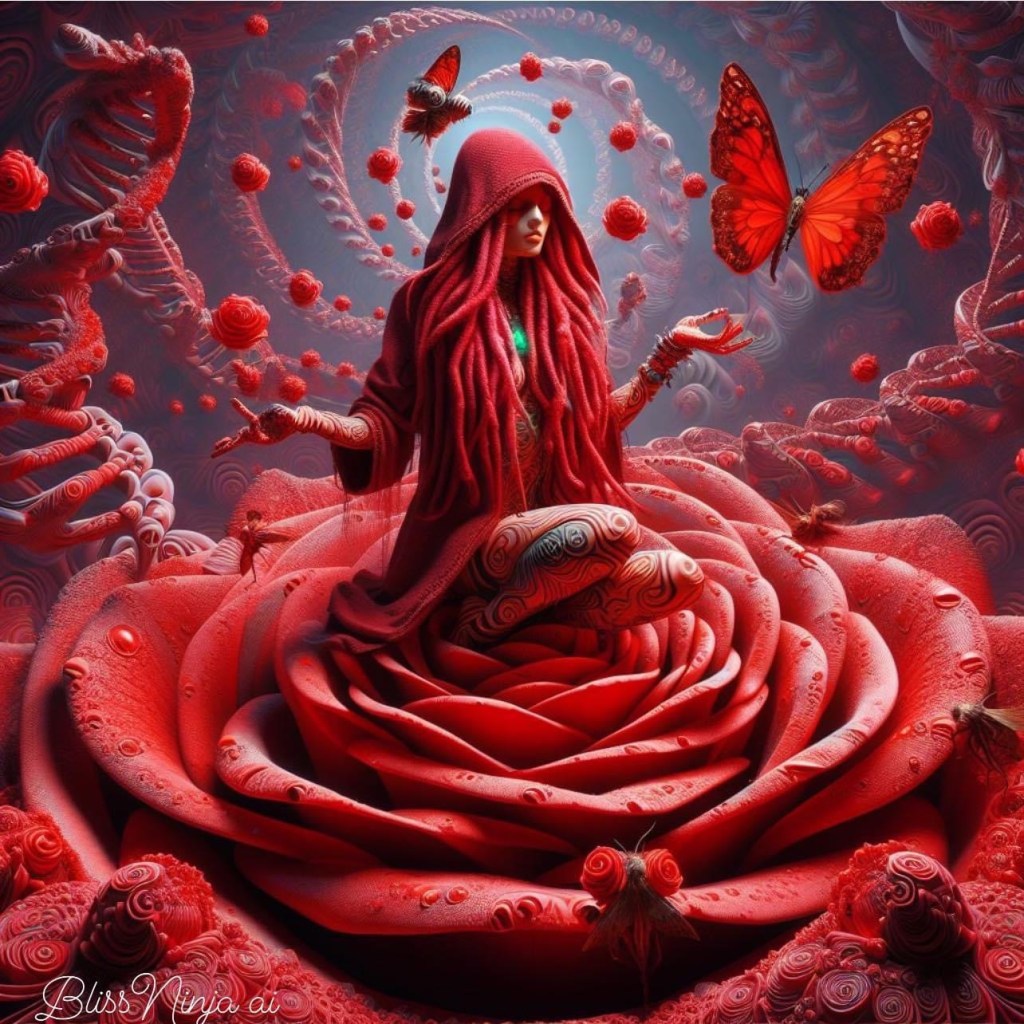
Shhhhhh…… Don’t write so loud- They might hear (Prying eyes that hide Inside Minds that fear…) These words tiptoe Down stairs Under where No one else knows… Somas Rose So full of Charge I fear I am larger Than Life can hold…. Lead into Gold As SunLight UnFolds Me From this bed Of salted tears I made As Dream wakes me Into playful prose Disguised inside These fleshly clothes…. That only a Poet Could Know.
“When we dance, we wake up, we get down and juicy with ourselves, we have fun and forget all the heavy shit we carry around. In the dance we get real, get free, get over ourselves. Movement kicks ass. When you truly surrender to your own rhythm, you look so cool, so mysterious, so seductive— the way you deep down really want to look but don’t trust that you do.”
Gabrielle Roth, Connections: The Threads of Intuitive Wisdom







 BlissNinja