Last time I saw Chaplin, all he said was, "Stay warm. Stay warm.”
(Groucho Marx in conversation with Woody Allen)
Last chance, last minute, last round, last inning, last exit, last ditch. Last rites, Last Supper, last days, Last Judgment. Last words, last breath. Last word, last laugh, last dance, last rose of summer, last good-bye. What an enormously weighty word! Why does it give such importance to the words it qualifies? And how does "last" bear on character? We shall have to find out.
Already I can tell you this: Our inquiry will aim deeper than the evident meaning of "the last time" " as the end and therefore death. If that were all, the inquiry could stop here, satisfied with this banal result. Remember, we are eluding death all through this book, trying to prevent death from swallowing into its im- penetrable darkness the light of intelligent inquiry. Death is a single stupefying generality that puts an end to our thinking about life. The idea of death robs inquiry of its passionate vi lality and empties our efforts of their purpose by coming to the predestined conclusion, death. Why inquire if you already know the answer?
If a pair of socks helped us in the previous chapter, the fic- ton of a couple may help in this one.
“She just got into her car and drove off. That was the last time I saw her." How casually the moment slips by, blurring into the everyday. But when the simple action is marked by "last." the event becomes an indelible image. "Last" makes an event eventful, elevates it beyond the everyday, leaves a lasting impression. Last words become "famous," " last moments enig- matic emblems to ponder for years to come.
Why? Because what happens at the end of a sequence stamps its closure, gives it finality. Reverberations of fate. The events that composed the marriage, the love affair, the life together be- come essentialized into the last scene. She gets into her car and drives off. To her death in an accident? To another city and a new start? To another lover? Home to Mother? Back to her husband and children? Where she drives to belongs more to the next story than to the last scene of this fiction of a jointly at- tempted life.
Had she returned later as on any other day, the image of her getting into her car would have no significance and therefore would not last. But now it tells of character: the abiding char- acter of the relationship- -its commitment to casualness; its apparent openness, which conceals truth. Or it reveals her re- bellious independence; or her adventurous courage; or her fail- ure of nerve; or her diffident coldness. .. . It says something about his character, too. the unspoken feelings; the dulled sensitivity that cannot perceive and does not foresee. Their character together, his, hers- last, as she drives off.
So the last time is more than information for a detective's re- port. "Just the facts." She does, in fact, just get into her car and drive away. But the last time transforms the facts into an image. The impression of her at the curb as the ignition catches lasts because it is compressed into a significant image, a poetic mo- ment. Other times are held captive by the last time and ever- lastingly signified.
Poetry depends on compression for its impact. The word for poet in German is Dichter, one who makes things dicht (thick, dense, compact). A poetic image compresses into a snapshot a particular moment characteristic of a larger whole, capturing its depth, complexity, and importance. By putting closure to a se- ries of events that otherwise could run on and on, the last time is outside serial time, transcendent.
This kind of moment is hard to bear and hard to relinquish. It feeds nostalgia, coming back to mind, a refrain that will not let go. Older age makes room for what T. S. Eliot refers to as "the evening with the photograph album," snapshots that bring back a world. ' Gerontology names these evenings "life review" and claims that they are the main calling of later years. Since anyone at any age can slip into nostalgic reverie, "later years" can be taken less literally, to mean a poetic state of soul favored by the old but not exclusive to them.
The last time turns love, pain, despair, and habit into poetry. It puts a stop to, arrests forward motion, and lifts life out of it- self. This is transcendence. We feel shaken to the bones, as if the gods had stepped into the middle of our lives.
Transcendence of the daily does not occur until the epiphany of the last time. She got into her car every day. The last time be- comes utterly different. In no succession of events do we imag- in any one moment to be the last. We can always come back another time, do this again. "The last time" says there is no "again." The last time is unique, singular, fateful. Pop lyrics play on this poetic moment: "The days dwindle down to a pre- cious few, September. .. " (Maxwell Anderson); "The last time we saw you . " (Leonard Cohen); "The last time I saw Paris" (Oscar Hammerstein), "Last time I saw him" (Pamela Sawyer); "This could be the last time ..." (Jagger and Richards), "The last time I saw George alive • (Rod Stewart). "Again, this couldn't happen again. "; etc. Each scene of life may be a last time, like the morning she drove off in her car.
To call the last time unique, singular, and fateful makes it sound inevitable and necessary, as if she drove off because it was determined by her character. If character is fate, as Heraclitus sald, then this was her day to die. Or she had to cut out, because *that's just the kind of freewheeling person she was; we should have expected it " Yet it might have been a spontancous impulse to which her character gave in: "Enough is enough; I'm out of here.” A whim, seemingly out of character. We can't know. For us the story stops as the car pulls away.
Right here, we have to be careful. Character could become an iron law, permitting only those acts that are "in character."In that case, the idea of character engenders little waves of repres- sion. "It's not my nature to do this, think that, want those, be- have like this." Is there no room for the spontaneous, for moments of speaking, thinking, and feeling quite "out of char. acter"? The answer depends on how we think about character.
I would claim that nothing is out of character. Character is inescapable; if anything were truly out of character, what would its source be? What stands behind a whim? Who pushes the urge and ignites an impulse? Whence do stray thoughts arise? Whims emerge from the same soul as choices and are as much part of your character as any habit. That last time belonged to her just as all the other times did. Belonged to her? Which "her"?
Her character must consist in several characters- "partial personalities," as psychology calls these figures who stir your impulses and enter your dreams, figures who would dare what you would not, who push and pull you off the beaten track, whose truth breaks through after a carafe of wine in a strange town. Character is characters; our nature is a plural complexity, a multiphasic polysemous weave, a bundle, a tangle, a sleeve. That's why we need a long old age: to ravel out the snarls and set things straight.
I like to imagine a person's psyche to be like a boardinghouse full of characters. The ones who show up regularly and who habitually follow the house rules may not have met other long- term residents who stay behind closed doors, or who only ap- pear at night. An adequate theory of character must make room for character actors, for the stuntmen and animal handlers, for all the figures who play bit parts and produce unexpected acts. They often make the show fateful, or tragic, or farcically ab- surd.
Fitting them in is called by Jungian psychologists integration of the shadow personalities. Fitting them in, however, means first of all finding them fitting, suitable to your idea of your character. The Jungian ideal calls for a more integrated charac- ter, for the full boardinghouse with no exclusions. This may re- quire conversion of the more disreputable and obstreperous to the morals of the majorin, an integration leading to the in tegrity of the matured character.
These noble ideals are better in the recipe than on the table. for old people, as Yeats wrote and Pound demonstrated, are often disheveled, intemperate, whimsical, and closer to chaos than to the sober well-honed wisdom that the idea of integra- ton suggests. The integrity of character is probably not so unitary , rather, the full company is onstage as at the end of the opera, when the chorus, the dancers, the leads, and the con ductor take their uncoordinated bows. Life wants the whole ensemble. in fagrante delicto. Even the cover-ups belong to the character.
The study of how each of these characters belongs is a main activity of later years, when "life review' consumes more and more of our hours. Whether going through piles of papers and closets of things, or regaling grandchildren with stories, or at- tempting to write autobiography, obituary, and history, we try to compress life's meanders and accidents into a "character study. That's why we need so many later years and why, as the days shorten, more and more evenings are absorbed in the photo- graph album. Regardless of whether contrition, nostalgia, or vindictiveness marks our feeling as we turn the pages, we are as engrossed in study as if for a final exam.
We study our character and others' for revelation of essence, and we read actions such as her driving away as compressed ex- pressions of this essence. She, at the curb, opening the car door, getting in and going off for the last time has become an in- delible image, an objective shot corresponding to her character. We study this poetic particular for descriptive predicates that might lead to predictions about her behavior. Other images come to mind--other times when her eyes shone with a wild light while she sat behind the wheel; casual words of envy at a friend's freedom; her collection of lightweight, thin-soled shoes; a girlhood story of a dangerous hike. This cluster of im- ages shows qualities that constitute her character: freedom, danger, movement, surprise. As these belong to her character so they can be predicted. Her driving off should be no surprise- providing we compact her character into only these compatible images, arrange them into a coherent story, and omit all that does not fit in.
What does not fit in demands all the more scrutiny and a widening notion of character. All we need to do is stick with the image, allow its complications to puzzle us, and abandon such superficial ideas of character as habits, virtues, vices, ideals. Ac- cess to character comes through the study of images, not the examination of morals.
The daily world is notoriously poor in this kind of study. The little schoolboy killer was such a quiet nice kid; the serial murderer was hardly noticeable and seemed like anybody else; the baby-sitter who abused her charges was so prompt and tidy and polite. Our restricted notion of character restricts what we are able to see in people. If people are prompt and polite, nice and quiet; if they lack noticeable quirks, we expect them to be tidy in character. Unless we have a trained eye for the signifi- cant discrepancy, our predictions will invariably be wrong. The crime comes as a shocking surprise, an act altogether out of character. A culture blind to the complexities of character al- lows the psychopath his heyday of mayhem. No one noticed any oddity because no one had an eye for it. So after the horror he is sent to be "seen" by the psychologists who now, post facto, know what to look for and will, of course, find it.
We are as we appear, yes, but only when appearances are read imaginatively, only when the perceiving eye studies what it sees as a lasting image. This eye looks at the facts for the significant gesture, the characteristic style, the verbal phrasings and rhythms. This eye is trained by the visibilities of human nature. It learns from "people-watching, " from movie close-ups, dance postures and dinner parties, body language, and the street. It sees an image, which Ezra Pound defined as "that which pre- sents an intellectual and emotional complex in an instant of time."2 Especially, I would add, in that instant we see as "the last time." The older we get the longer we look, and want to look.
A woman of one hundred and three, living in Nevada, de- scribed her desire:
I want to start a wedding chapel. ……. I would just sit in a nice chair and let ... whoever I hire do the strenuous work. The reason I'd like a wedding chapel is that I could study the peo- ple. I could see what kind of man she's going to marry, and what kind of woman or girl she is. I can tell, I can tell.
Al Hirschfeld, artist and caricaturist, at ninety-five declares:
What's a man to do? Sit around some sun-soaked beach all day? Watching the waves? Or playing golf? Human beings fascinate me. People. I used to love just sitting in the window of the Howard Johnson's at Forty-sixth and Broadway, draw- ing the constant parade of people passing by. . .. Ill draw a bow tie, or a cane, or jot down one word or make a sketch that brings back an entire scene.
The eye for the image cuts to the essential.
In our overpsychologized culture, psychological testing sub- stitutes for this seasoned eye and prevents its development. In- stead of looking, we test; instead of imaginative insight, we read write-ups; instead of interviews, inventories; instead of stories, scores. Psychology assumes it can get at character by probing motivations, reaction responses, choices, and projections. It uses concepts and numbers to assess the soul, rather than rely- ing on the anomalous eye of a practiced observer.
The anomalous eye is the old eye. The older soul, aged into its own peculiarity, cannot, in fact, see straight at all; it favors the odd. Love of the odd may appear early in life, with the af fectionate nicknames children give one another and that single Out a particular feature or trait of character. But usually youth prefers conformity, trying to adjust or smother what does not fit in. In late life, having now become studies in uniqueness, we look for companions as odd in their ways as we are in ours. Similarities in daily routines, similar past experiences, parallel symptoms, common backgrounds are not comforting enough The fun, the love comes with companions in uniqueness. The odd couple: a couple of oddball characters.
The term "gerontology" should more rightly refer to the kind of study we do with our old eye than to the study of old age by young psychologists. Our studying does not aim to un- cover why she got in the car and drove off. The cause is already given: It was necessary because it was in her character. No use laying out the reason--she felt trapped; she had a secret; it was her time; she went schizoid and fled from love, or was a para- noid and fled from demons, or a sociopath and took the money and ran. We have little interest in exculpatory causes, such as her mother, her childhood, her horoscope, her awakened femi- nism. Conventional generalities explain nothing to the old ob- server. The anomalous eye just likes to watch, to sink deeper into the puzzle of human character which increases tolerance for human oddity.
Instead of coming up with reasons and diagnoses, we study the image. Our curiosity focuses upon the image of the last time, on her behavior as a phenomenon, on the image as an epiphany, for it is the image that lasts and can be reflected again and again in a variety of stories, exhibiting character in action. She was performing a drama, in which, as Aristotle said, char- acter is revealed through action.
Her last scene is also dreamlike, a tableau: the curb, the car, the key in the switch. In a dream we never know the motive for anyone's action or the diagnosis of anyone's problem. Psychol- ogy begins in the morning. We do not know the reasons for what dream people do, how they were treated in childhood, or even why they are there at all. The more the dream strikes us as an image- and each dream is a one-and-only, last-time dream- the less we can formulate it, yet the more we can re- turn to it and draw from it. Everything we look upon seems odd, as if seen for the first time, or the last. Something re- demptive happens. "We are blest by everything, / Everything we look upon is blest," writes Yeats- the last, and lasting, lines of one of his reflective poems on aging published when he was sixty-eight.
Blessing is the one gift we want from the old, and the one great gift only they can bestow. Anyone can applaud above- average achievements and award the outstanding. The old, however, are able to recognize the beauty that is hidden from usual sight, not because they have seen so much through the vears, but because the years have forced them to see so oddly. What one needs blessed are the oddities of character specific to our solitary uniqueness and therefore so hard to bear. I can bless my own virtues, but I need a well-trained, long-suffering eye to bless the virtues concealed in my vices.
A culture is preserved by the old. This cliché usually means that they guard the old ways, the old knowledge, the old stories; they are wise and give prudent counsel. Rather, I think, culture is preserved by the old because they enjoy the odd, study oth- ers for it, and locate the essence of character in what is peculiar to each phenomenon. A culture that does not appreciate the character of anything eccentric to its model tends to homoge- nize and to standardize its definition of the good citizen. The old preserve culture by means of the stubborn sameness of their unsuitable peculiarities.
The increasing importance of oddity as we age shifts the idea of character from the constitutive center of a human being out to the edges. The character truest to itself becomes eccentric rather than immovably centered, as Emerson defined the noble character of the hero. At the edge, the certainty of borders gives way. We are more subject to invasion, less able to mobilize de- fenses, less sure of who we really are, even as we may be per- ceived by others as a person of character. This dislocation of self trom center to indefinite edge merges us more with the world, so that we can feel "blest by everything."
C. G. Jung spent his more than eighty years following the Delphic maxim Know thyself" Self-examination and inquiry into the self of others was his lifework and formed his theory. Yet, amazingly, this is what he writes on the very last page of his autobiographical memoir:
I am astonished, disappointed, pleased with myself. I am dis- tressed, depressed, rapturous. I am all these things at once, and cannot add up the sum. I am incapable of determining ultimate worth or worthlessness; I have no judgment about my- self and my life. There is nothing I am quite sure about. When Lao-tzu says: "All are clear, I alone am clouded," he is expressing what I now feel in advanced old age. ... Yet there is so much that fills me: plants, animals, clouds, day and night. and the eternal in man. The more uncertain I have felt about myself, the more there has grown up in me a feeling of kinship with all things. In fact it seems to me as if that alienation which so long separated me from the world has become transferred into my own inner world, and has revealed to me an unex- pected unfamiliarity with myself.
Let us review for the last time her departure. That image offers one more allegory for imagining character. Her move exposed a dimension that he at the door had never been able to perceive, owing to the assumptions he made about her charac- ter. What he could not see before, he sees only too clearly now, in his imagination. Perhaps, until she turned the key, she, too, was ignorant of this depth of potential, this eccentricity. Nor had either of them a foreboding of sudden death--if that is where she went.
We come to realize that character dissolves into stories about character. We become characters in these fictions; this implies that the very idea of character also becomes a fiction--and therefore vastly important, for it generates imagination much as her image in this chapter provoked our imagination to invent fictions about her character and about the idea of character.
This is why the idea of character is so needed in a culture: It nourishes imagination. Without the idea we have no perplex= ing, comprehensive, and long-lasting framework to ponder; In= stead we have mere collections of people whose quirks have no depth, whose images have no resonance, and who are distin- guishable only in terms of collective categories: occupation, age, gender, religion, nationality, income, IQ, diagnosis. The sum of these adds up to a faceless Nobody, not a qualified Each. Without the idea of character, no single person has a lasting value. If each is replaceable, each is also disposable. The social order becomes like a battalion under fire; we are all replace- ments, filler for empty slots.
Character itself dissolves into fiction, as she does in our imaginings about her character, but the idea of character makes the fiction lasting. The idea keeps us inquiring, makes us look more closely at the snapshots. Her image spurs our imagina- tions. We want to know her better, see who she really is. Yet "who she really is, " her literal character, is only literary, only a figure in the stories in which she is the main character, and that is what lasts even when she has gone.
We, too, last as fictional images, whether in the reminis- cences of family, the gossip of detractors, or the reports of obituarists. Our character becomes the fertile source of fictions that add another dimension of life to our lives even as we fade as actualities. Jung realized this truth in his very late years, find- ing that he had become unfamiliar with the character he had as- sumed himself to be. His self-same reality became porous, indefinite, susceptible. As he wholly loosens into the world of "plants, animals, clouds" and is assimilated by the natural World, his character in the imagination of the human world continues to last, and goes on generating stories of who he really was.
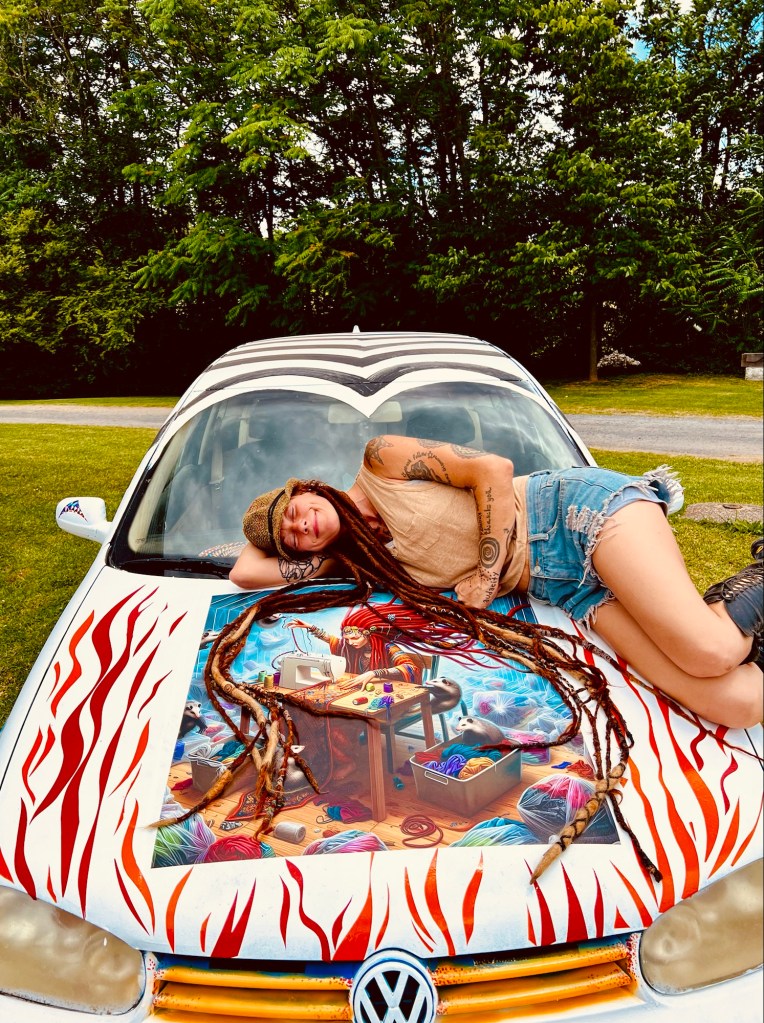
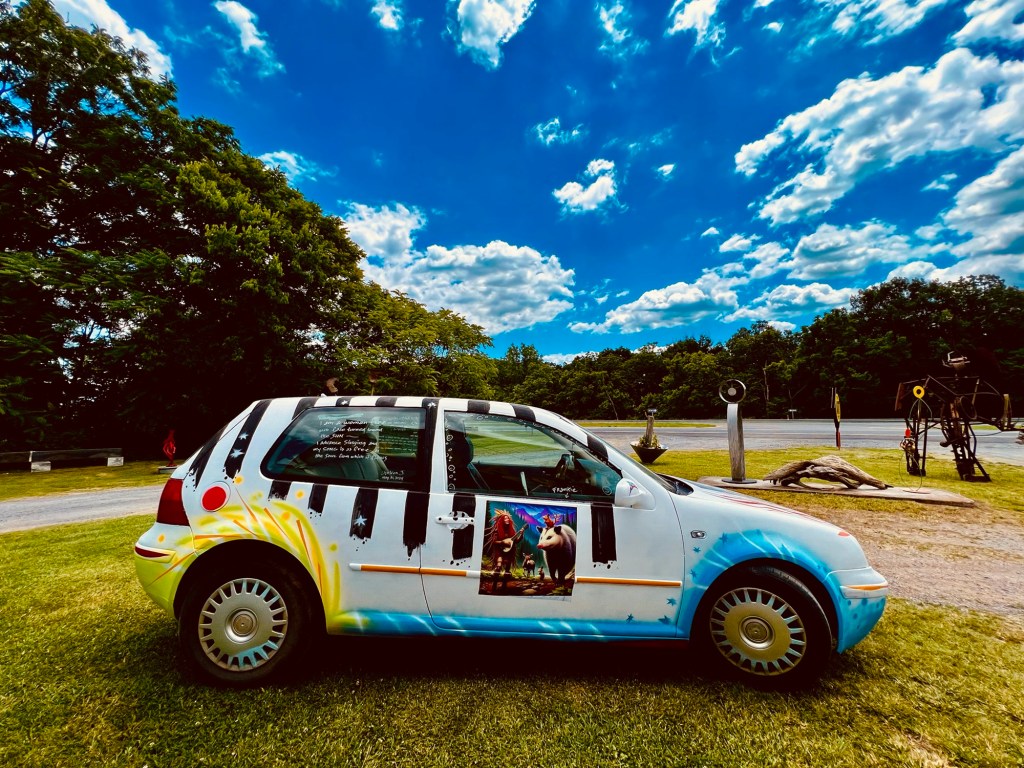
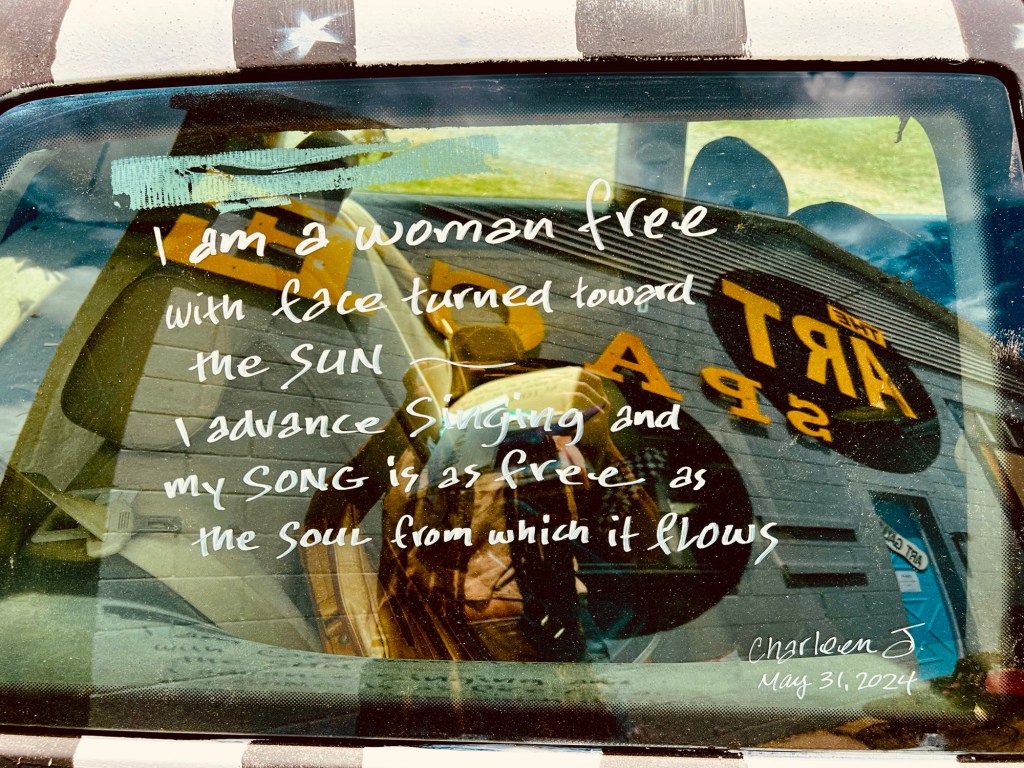
The Ninja Steed has resurrected!!!!! Fresh paint and art and all the goodness and Happy vibes, thank you mister Happy (James Kuhn )for this fabulous expression of the BlissNinja creed 🔥🌟🃏🌟🔥
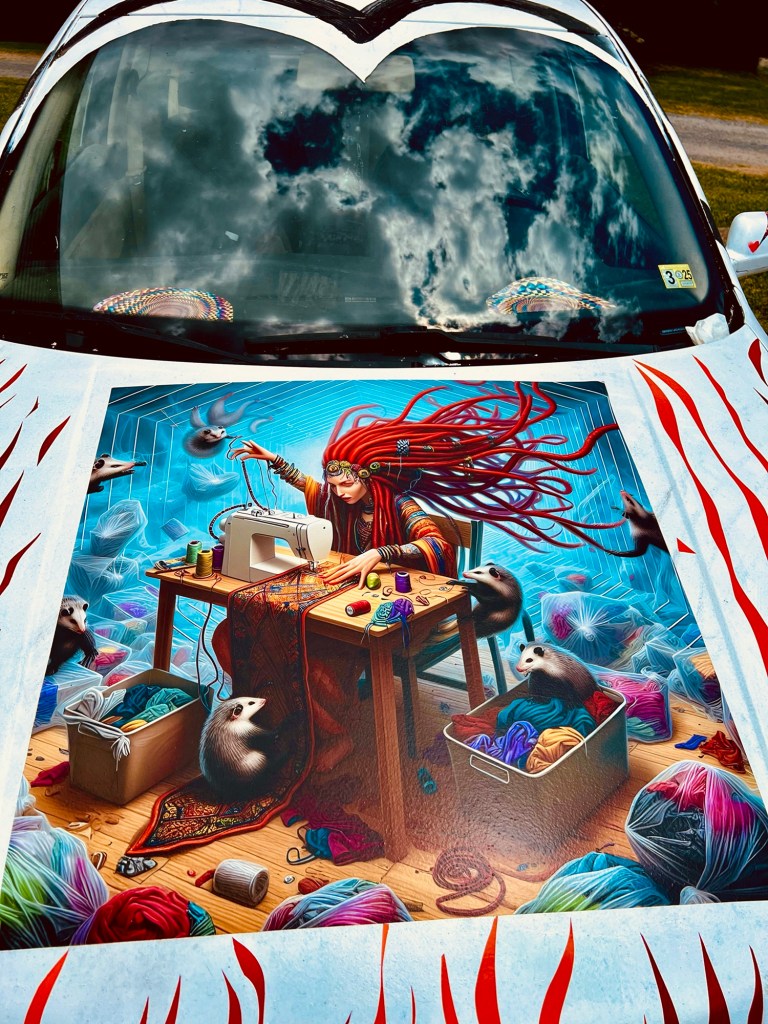
Happy had some of my ai art with Frankie the opossum etc printed into vinyl and adhered to car, and it’s so fun!!!!! Along with my business logo and the artspace logo and other amazingness.
It looks nice and colorful and fun outside of The Art Space on 211!!!!!!!!!!
Charlene, also spelled Charleen and Charlyne, is a feminine given name, a feminine form of Charles coined in the United States in the nineteenth century; from French Charles, from Old French Charles & Carles, from the Latin Carolus, from and also reinfluenced by Old High German Karl, from the Proto-Germanic *karlaz (lit. “Free Man”/”Free Spirit”/Free Thinker); compare the Old English word churl and the Old German Kerl. Meaning Free Woman, Free Spirit, Free Thinker
Self Portrait~ Charleen Johnston 5-28-24
THE SONG OF A WOMAN FREE
I am a woman free. My song Flows from my soul with pure and joyful strength. It shall be heard through all the noise of things — A song of joy where songs of joy were not. My sister singers, singing in the past, Sang songs of melody but not of joy — For woman's name was Sorrow, and the slave Is never joyful tho he smiles. I am a woman free. Too long I was held captive in the dust. Too long My soul was surfeited with toil or ease And rotted as the plaything of a slave. I am a woman free at last After the crumbling centuries of time. Free to achieve and understand ; Free to become and live.
I am a woman free. With face Turned toward the sun, I am advancing Toward love that is not lust, Toward work that is not pain. Toward home which is the world, Toward motherhood which is not forced, And toward the man who also must be free.
With face turned toward the sun, Strong and radiant-limbed, I advance, singing, And my song is as free As the soul from which it flows. I advance toward that which is, but was not; Toward that which is not, but is yet to be.
I, the free woman, advance singing, And with face turned toward the sun. Let Ignorance and Tyranny Tremble at the sound of my feet. I am a woman free.
Singing the song of joy, Strong and radiant-limbed, I advance toward the work which waits for me, The joyful work out in my home the world ; And toward the man who is my mate. Oh I am strong and magnetic — I have not wasted myself in sensuality; And equally strong and magnetic Is the man who is my mate.
For the glory of Motherhood I have conserved my strength. And for the glory of Fatherhood He has conserved his strength. I have passed by the lovers Who passionately called to me in the name of love, But whose lips were only hot with lust. I have remained true to my own soul And to the souls which are enfolded within me • And no man shall mingle his body with mine Who is not pure.
I am the free woman, No longer a slave to man, Or anything in all the universe — Not even to myself.
I am the free woman. I hold and seek that which is mine : Strength is mine and purity; World work and cosmic love;
The glory and the joy of Motherhood. I am not strong and clean for myself alone, But for all people ; My work and my love are for all people ; And I shall not be the mother of one child, But of all children — For I myself am the daughter Of all women and all men. Oh I am free ! My song Flows from my soul with pure and joyful strength ; It shall be heard thru all the noise of things — A song of joy where songs of joy were not.
Oh I am free ! I thrill With radiant life and gladness. I advance toward all that waits for me. I chant the song of Freedom as I go. My face is toward the sun, My soul is toward the light, My feet arc turned toward all that waits for me. I advance! I advance! Let Ignorance and Tyranny Tremble at the sound of my song!
There is really nothing more to say when we come back to that beginning of all beginnings that is nothing at all. Only when you begin to lose the Alpha or Omega do you want to start to talk and to write, and then there is no end to it, words, words, words. At best and most they are perhaps in memoriam, evocations, conjurations, incantations, emanations, shimmering, iridescent flares in the sky of darkness, a just still feasible tact, indiscretions, perhaps forgivable….
City lights at night, from the air, receding, like these words, atoms each containing its own world and every other world. Each a fuse to set you off…
If I could turn you on, if I could drive you out of your wretched mind, if I could tell you I would let you know.
RD Laing ‘Bird of Paradise’
Back and forth Ive gone, trying to decide which framework to use to tell my story, to evoke my past selves, to conjure the spirits of my composted dead….the spells of words, words, words to wrangle language into incantation and summon sensation from the tangled threads. Best to start from the beginning, so there is proper context for the cycles and patterns. My intention is to psychologically and astrologically deep-dive through the mythic landscapes of my narrative, as well as using Dreams and other dimensional experiences…..and journals and poetry that span my life…….creating a Quantum Astropsychography.
This is really an extended Uranus opposition Ritual, a systematic series of inner journeys into the deeply buried memories that are tangled up in the fascia of my body and in deep underground psychic gulag that holds soul shards, waiting for my return and to be released from their Prizm Cells. 18 months approximately of transits that will shake up the structures of my life and ego once again, so that I can be patchworked back together in a more meaningful way, ready to start the next leg of my journey of embodiment here. I must let go of it all. Surrender the moments and mysteries and experiences that have sculpted me. And start anew, as a sovereign Self in the playground…..ready to create and to embrace all that Life asks of me in this new reality (with its ever-more-shaky foundation). Pluto into aquarius, is bringing the reflection of a way of life that will rapidly become unrecognizable. My sons descendant is 2′ aquarius and his 5 planet stellium in early aquarius opposing natal saturn has me open-eyed waiting for what magic and transformation he will undergo over the next decade. He just turned 18. I cant help but be nervous, knowing all too well the many plutonic crisis’ that define my own life journey. And wondering what sort of games the lord of the underworld has in store.
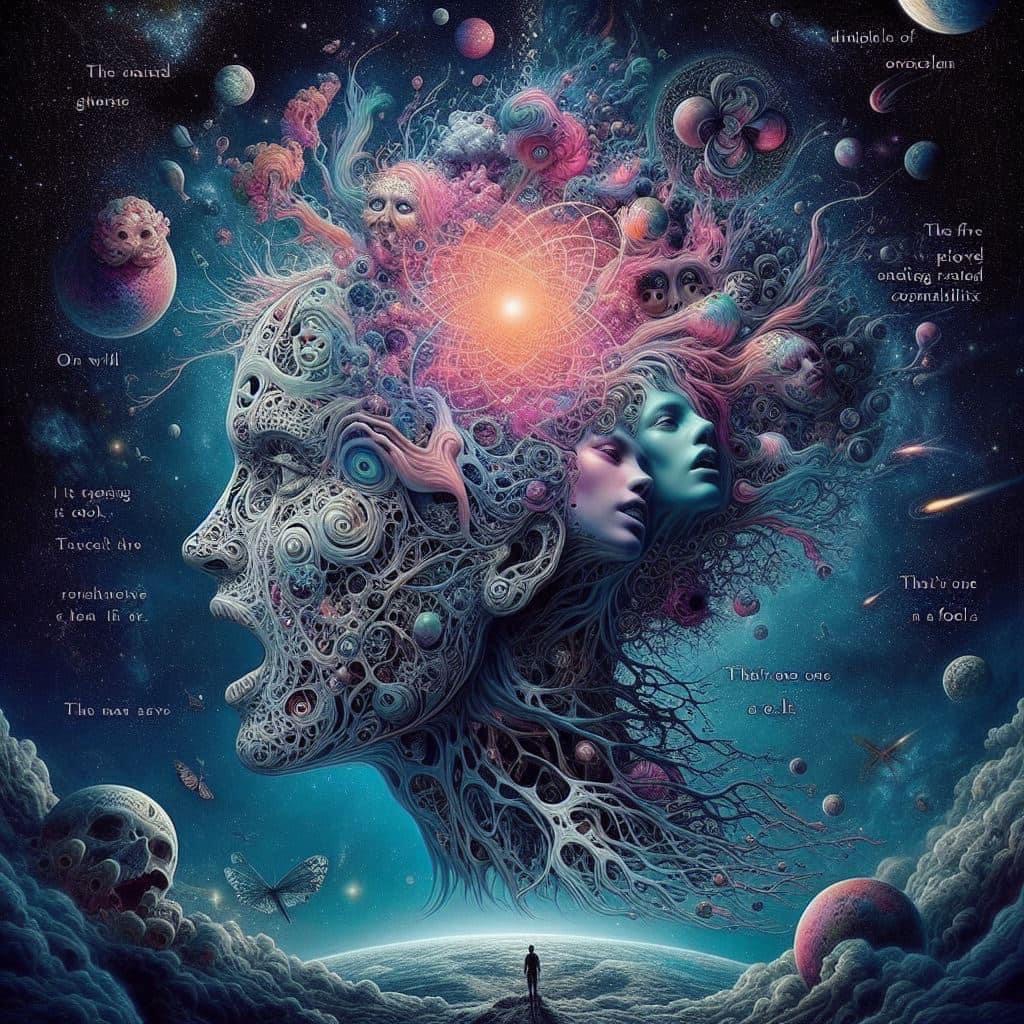
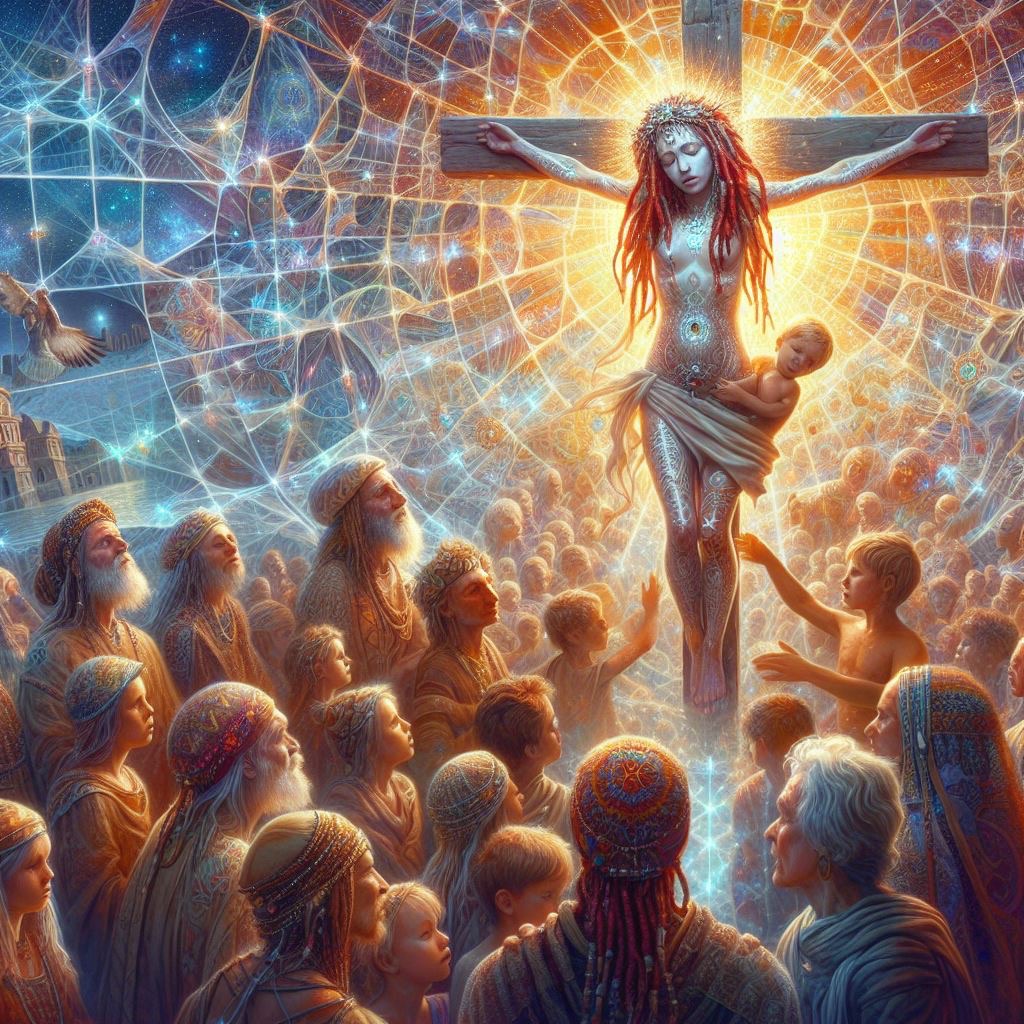
BlissNinja ai generated art
I have watched sons Claim Their names beneath The sun, I have seen the same Done To me, I have been a child I have been a whore I have been a maniac Knocking on gods door, And in the neon The glow The bliss that sometimes We know I have melted like Wax And my heart has Dripped right Through The cracks in your Floor.
“As adults, we have forgotten most of our childhood, not only its contents but its flavor; as men of the world, we hardly know of the existence of the inner world” we barely remember our dreams, and make little sense of them when we do; as for our bodies, we retain just sufficient proprioceptive sensations to coordinate our movements and to ensure the minimal requirements for biosocial survival- to register fatigue , signals for food, sex, defecation, sleep; beyond that, little or nothing. Our capacity to think, except in the service of what we are dangerously deluded in supposing is our self-interest and in conformity with common sense, is pitifully limited: our capacity even to see, hear, touch, taste, and smell is so shrouded in veils of mystification that an intensive discipline of unlearning is necessary for anyone before one can begin to experience the world afresh, with innocence, truth and love.”
RD Laing ‘the politics of experience’
Many years ago when I was about 21 I discovered RD Laing ‘The Divided Self’ , which was one of many valuable books I read that helped me be comfortable with my psychological state and the way I navigated the world. Recently I picked up his book ‘The Politics of Experience’ and within the first chapter he brilliantly articulates what became obvious to me way back as a teenager. But on the eve of starting the deep dive into my own life via autobiographical storytelling, and the eve of my sons 18th birthday, I read some passages that really capture my reasons for making the decisions Ive made in my own childrearing and in all aspects of my life. Early on I saw the truth of the above quotation, and I vowed never to be the ‘normal man’. Ever since I can remember, my first memories are realizations that I was ‘mad’ and not like the creatures around me. As I got a little older, the fact of madness haunted me. Just beyond the curtain of everyday life, the Madwomans Whisper called to me, beckoning me to follow into realms little understood, and which excited me, yet also left me vulnerable to the alienation of the common crowd. And instead of cowering in the face of madness, I have done my best to live out my truth in defiance of the mediocrity of modern expression. Ive raised my son to be a sovereign individual willing and able to step away from the consensus, with confidence in acting in a manner far from the ‘maddening crowd’.
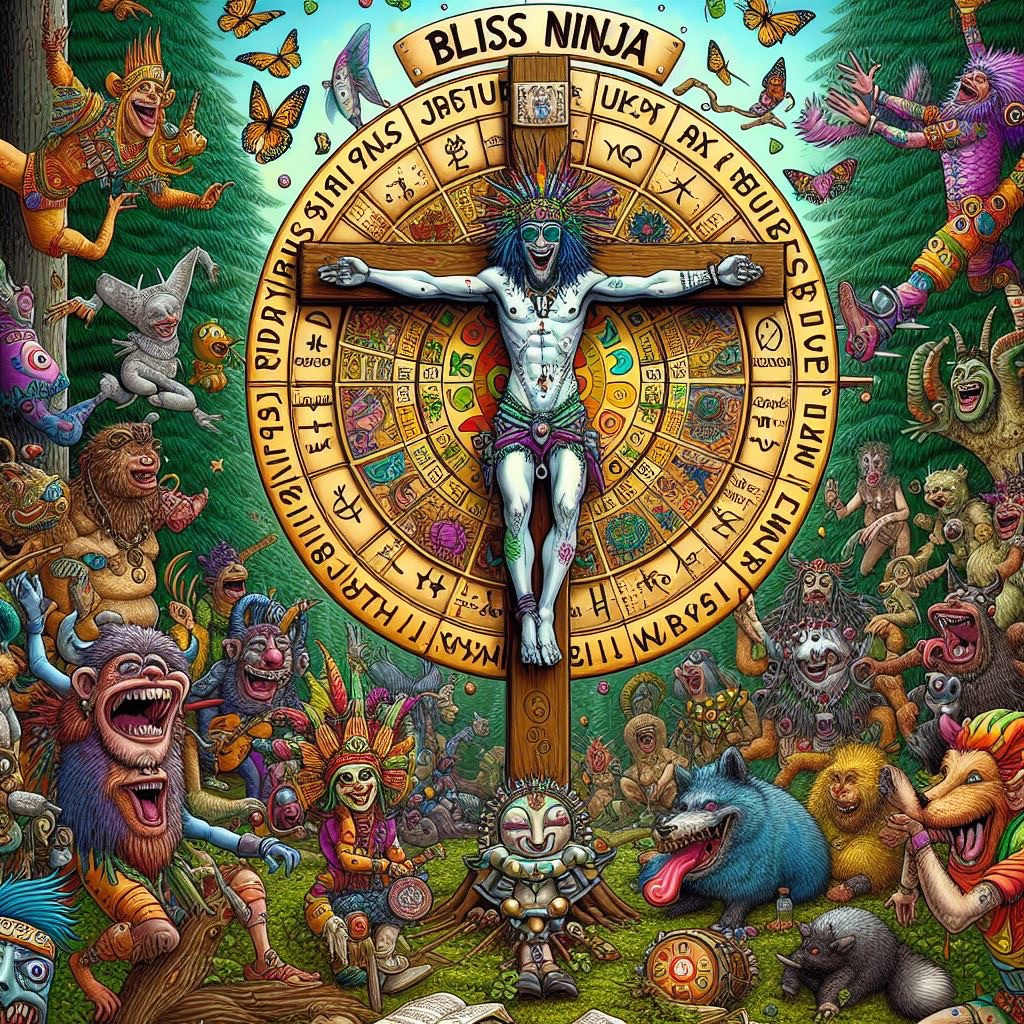
BlissNinja ai generated art
“What we call “Normal” is a product of repression, denial, splitting, projection, introjection, and other forms of destructive action on experience. ..It is radically estranged from the structure of Being.
The more one sees this, the more senseless it is to continue with generalized descriptions of supposedly specifically schizoid, schizophrenic, hysterical ‘mechanisms’.
There are forms of alienation that are relatively starnge to statiscially ‘normal’ forms of alienation. The ‘normally’ alienated person, by reason of the fact that he acts more or less like everyone else, is taken to be sane. Other forms of alienation that are out of step with the prevailing stage of alienation are those that are labeled by the ‘ normal’ majority as bad or mad.
The condition of alienation, of being asleep, of being unconscious, of being out of one’s mind, is the condition of the normal man’.
Society highly values its normal man. It educates its children to lose themselves and to become absurd, and thus to be normal.
Normal men have killed perhaps 100,000,000 of their fellow normal men in the last fifty years.
Our behavior is a function of our experience. We act according to the way we see things.
If our experience is destroyed, our behavior will be destructive.
If our experience is destroyed, we have lost our own selves.”
RD Laing ‘the politics of experience’
How we experience ourselves and the world around us, including other beings, shapes how we act and how we think and how we create structures to contain our lifeforce. Our experience has been intentionally manipulated. The fog of delusion that humanity lives within is imperceptible to the average person, except through the vague feeling-sense of what is missing. In performing a ‘retrospective’ of my life, up to this point, at 43 years old, I intend to do soul retrieval to all those sparks of Life and Self that are trapped in the psychic gulag of my hologenetic Body of Experience. The act of re-entering these spaces, to free these selves, and to articulate and tell the story of my own Mythological existence, is to do my part in reMembering Wholeness. It is my Gift to the larger Body that I exist within, to tell my story and to untangle the knots of energy that bind my power to old dreams and dramas and to deliver my own Self as the birth pains of Sovereignty make any other life impossible. Theres no way out but in. Into the Body, into the Cellves, into the tIssues and into the Fascia which is the crystalline template holding the seed.
There are some Wakings that come like storms Electro-swarms in magnetic forms Dancing On the tips of Hathor’s Horns The Temple Priestess ReBorn WideEyed and Me-oh-my How Time Flies inside the Mind Wandering Womb releasing Blind sides of Ancient crimes Buried within these patient Tombs There are some Wakings that scream like pain Neurolinguistic nails impaled in veins Bleeding And Seeding Stories in silent Shame The Holy Harlot Risen OpenHearted as freedom Parts The Seas of Self and Dwells in the Art Of Body’s Bliss Burning The rotting dross from the Fixed Cross As the Flame is taught to rekindle the Kiss As Magdalenes Grail Returns Opens the Urn Blood flooding in rivers of nerves As the Impaled Heart And Mind Are Healed and Heard…. The Chironic Wound sutured With the Salve of Spoken Words As Pluto and Venus Sharing the Shroud Awake and merge…. Heiros Gamos Blessed and Bound In Sacred Sound Dance In Red Velvet Underground As New Life Stirs.
In the in Between Before the dream Overtook me... That effervescent beam that clings Like dew to my Mindscreen After the dark night has risen Like yeast inside of me Shone Daimonic face The trickster dressed in lace And leather And choking on feathers From my Flock Mocked me Pointed to the clock And shook me from complacency The Red Tale of Fires embrace Rose like dawn And threatened my Face With scabs of disGrace from legions Spawn Fighting for ascendancy As I silenced the grim Grip Of their insistent Whims And kept right on The same old track Of dependency Ignoring the tortured truth That swarmed my limbs And swore to remain imprisoned Within... Spoken to me in a cross Between Whisper and Scream As I lay Trapped in stasis Peering at faces Whose skin peeled like panic From the ancient Dream... ...Worry of whether I'm worthy of the flame Grateful for the shocks And the shards and the pain That lodge within The neural Stains And strains of my heaving Heart... "Stop Showing off... And Make Real Art" ....and in a flash The great Rash of Impulsive Inaction Flickered in the Smile Of the Vixen who agreed To stop feeding On my flesh If I vowed To rise from the bowels Of this Blessed Test Of Will And say Goodbye To Patterns that Shatter The Sanctity of Time Trapped within loops Of Mind... As I Bleed within Mother Matter in Fractal Flowers that Unfold In Sacred Sines.
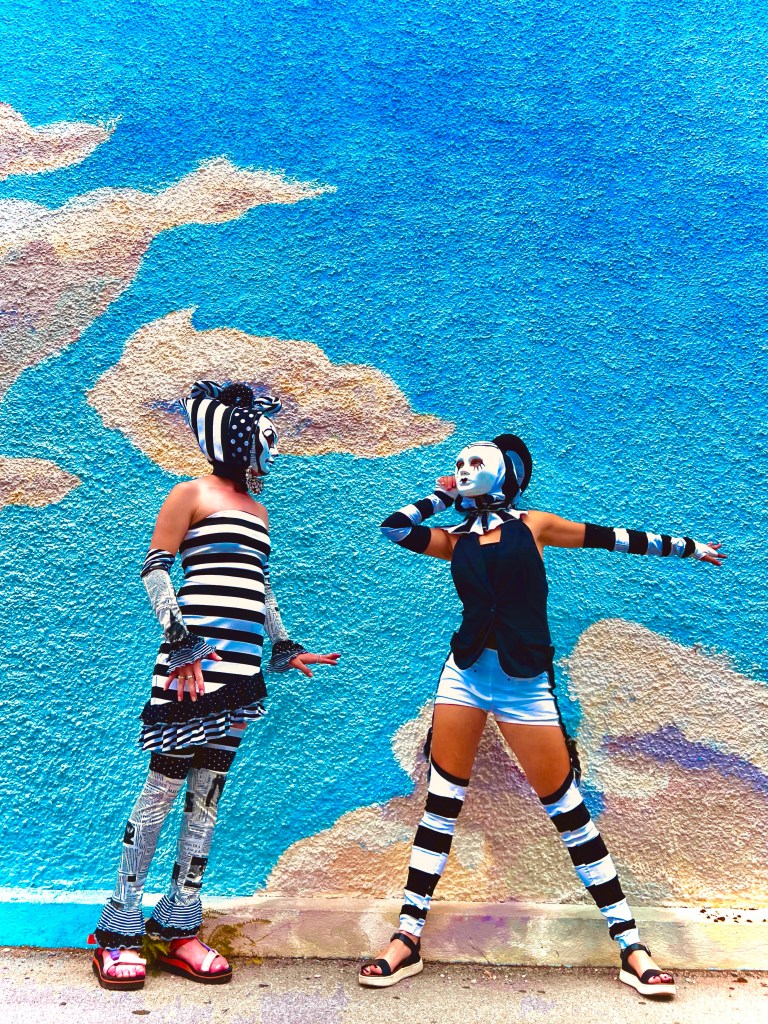
Photo by me/Charleen Johnston. Models Reese Miller & Drea Bleu Good-Brown
A counterBalance ...perhaps.... When the chasm beckons And the perilous chapel Seeks it's reckoning Thru maladies and maniacal Mishaps That overlap Present & Past Times That threaten to Bind Tight The blind spots with tangled knots In games of Daimonic power Buried In unfolding fractal flowers Of 'Sight Or Blind DeLight ' As the shattered Tower Falls And Offers its gift
A suture to bridge the rift
Shall i Fly from this precipice Or fall to my Death As the urge to transcend The Bond of Breath
Time and Space are not different but constitute the active and passive, the expressive and receptive, the electrical and magnetic aspects of the same reality. Time consists of currents in space and space forms the background and latent energy of time.
S p a c e. I n. M o t i o n. I s t i m e & t i m e a t r e s t I s. S p a c e. In this regard, Space is eternal and time is unbounded.
Space consists of sound or vibration which is the Seed of Time. From that time-space vibration all mantras abide as the root ideas of the Cosmic Mind. Sound upholds Space and imparts meaning to all existence. Sound creates Time as the basic movement of the breath. From the unmanifest sound of space arises the manifest sound of air, which is the movement of space. Out of the sounds of air all other sounds are created. The mind has its own special space that holds all words, sound and meaning.
~David FrawleyThe Movement of Space is the dance of the cosmic air or Vayu, from which the breath or Prana of Shiva arises. The Breath of Shiva creates time, which is transformational movement in space. The Mind is our inner Space in which our own life-energy moves. Yet air and Prana as the movement of space are also Time. They create their own times and the lifetimes of both all creations and all worlds.
Prana, Pranava, Akasha, and Kala or primordial life energy, sound, space, and time are ultimately one and intimately related as powers of consciousness. Each is a manifestation of the other. Each is contained within the other. And through mastering one, the others can be mastered. Time is a manifestation of space and carries the energy of Prana or the Universal life. Time is the divine word or Pranava that directs the destinies and karmas of all creatures and all worlds. The energies of Time, Sound, and Prana are but the vibrations of Spacebsnd one with it.
David FrawleyThe Power of Time ( Kala Shakti) is the Goddess Kali, who is the power of action ( Kriya Shakti) in the universe bringing about the full unfoldment of the cosmic dance of Shiva. The original power of action does not simply promote any type of activity but energizes the evolution of consciousness. Kali is also the Prana Shakti as the power of eternal life that overcomes all death and limitation.
Kali is Shivas own Shakti or the power of Shiva in his own nature, his ability to be himself. Kali is ultimately the timeless presence of the supreme space of Being into which everything is dissolved.
~David FrawleyShiva as eternal time is the energy that dances on the stage of Shiva that is infinite space. Time is the movement of Space, the waves formed on the ocean of space, which is the dance of Shiva. The dance of time is Shivas fiery dance of dissolution, his Tandeva or dance of thunder, high also has its power to create, preserve and transform, as well as to ripen and mature.
Where will this feeling take me Will it make me into love? The open noose Hangs like fruit From the ripened Wheel above My open mouth Crying out As milk of Mother spills in anger Over My tangled tongue




























 BlissNinja